The Dambusters

Today the seventieth anniversary of the Dambusters raid is being celebrated as a patriotic triumph in Britain. ‘Operation Chastise’, the official name of the action, was an attack on German dams, carried out on 16–17 May 1943 by the Royal Air Force, using a specially developed ‘bouncing bomb’. Many planes were shot down and many young RAF airman died, sacrificing themselves for the war effort.

As a result of the raid, the Moehne and Edersee Dams were breached, causing catastrophic flooding of the Ruhr valley and of villages in the Eder valley. An estimated 1,600 people were drowned. Although German war production was temporarily affected, the damage was mitigated by rapid repairs by the Germans, with their production returning to normal in September.

Initial German casualty estimates from the floods when the dams broke were 1,294 killed. This included Allied POWs and, in particular, 749 Ukrainian women, kidnapped slave workers. Later estimates put the estimated death toll in the Möhne Valley at about 1,600, including people who drowned in the flood wave downstream from the dam. Today, let us remember in prayer the Ukrainian Orthodox women, innocent victims of the most barbaric war in human history.

To the Innocent Victims of the Dambusters Raid, Eternal Memory!

See:

http://www.telegraph.co.uk/history/britain-at-war/10061005/Hour-by-hour-how-the-Dambusters-raid-unfolded.html

http://airrecce.co.uk/WW2/imagery/Dambusters/Dambusters.html

Questions and Answers from Recent Correspondence: April-May 2013

Q: What is the essential difference between the Western world and the Orthodox world

A: The Orthodox world chose to follow the Gospel. However, at the start of the second millennium the Western world finally chose to follow the pagan Roman Empire, from which it inherited its pride and aggressiveness. Thus, when the British set up their Empire, their symbol was Britannia – the Roman name for Britain. And the French and the Germans, let alone the Italians, also used the Roman Empire and its symbols and insignia as their models. Even today, the heir of Western Europe, the Far West, the USA, treats the world as its Roman Empire, sending out its legions to conquer it and exploit it.

Q: What does this mean for Western religion?

A: As for the religion of the West, it was long ago deformed by the filioque heresy, which expresses the concept that all the Spirit and authority of God lies with Western man. This is not Christianity, this is racist neo-paganism. As a result of this humanistic deformation of the filioque, the West has come to lack the sense of the sacred, of the presence of God in its midst. As a result of this, it has in turn come to lack the sense of the ascetic, the sense that we can raise ourselves up to God through inner cleansing, and therefore it also lacks the sense of compassionate love, the fruit of this ascetic struggle. And as a result, it makes continual war, having developed the most incredible and costly technology to destroy all humanity several times over and indeed our whole planet, thus achieving the ability to end the world.

Here is the difference with the Orthodox world. And there are few places in the Orthodox world where this sense of the sacred, the sense of the ascetic and the sense of compassionate love been better kept than among Russian Orthodox. This is exactly what the 20th century Russian Church Father, Metr Antony (Khrapovitsky) of Kiev understood so well. Those Orthodox who have not been contaminated by the West still possess the sense of God and man, whereas the West made sinful man into a god; already by the Renaissance, man was declared to be a half-god. This is why today the strange idea of homosexual marriage was born in the West. This is a throwback to the religion of pagan Rome and Greece, where gods and goddesses cavorted with men and women alike.

Q: Western religion is divided into Catholic and Protestant branches. Is there any difference between them?

A: There is no essential difference between Catholic and Protestant; they simply represent different stages in the process of degeneration, in the process of the loss of the sense of the sacred, of the ascetic and of compassionate love. These three values were replaced by scholasticism (the cold, calculating reason replacing the warm heart), ritualism (the outward replacing the inward), and nationalism (hatred for others replacing love of the familiar). In Catholicism this loss of the sense of the sacred can be seen very clearly over the last fifty years. Today, in their services Catholic priests turn their back on God and face the people who sit down; they have mostly done away with the veneration of relics, with fasting and ascetic struggle. Aseticism has been replaced by its opposite – consumerism. And yet, remarkably, traces of the sense of the sacred and the sense of the ascetic and even of compassionate love, can be found in Islam, Hinduism and even Buddhism, which is not a religion, but a philosophy. In this respect, the contemporary Western world stands out as the one exception in the history of civilisation, which is a sure sign of its decadence and coming collapse.

Q: You said that Western religion is racist. In what way is this true?

A: Western religion at first concerned only the Western elite, only later in general Western man (not even Western woman). It certainly was not concerned with other races, whom it looked on as inferior. For example, many of the American humanists of the eighteenth century had slaves – just like the Roman humanists some 2,000 years before them. And the belief of the British Empire was: ‘God is an Englishman’. It is only in the last fifty years that Western humanism has decreed that women, Africans, Asians, the handicapped and now homosexuals, and people of all races, are also gods – only provided of course that they first adopt the deluded Western ideology.

Q: But there are plenty of Orthodox who can be as cruel and proud as such Western people and there are many Western people who are neither cruel nor proud. What do you say?

A: Oh, there are a great many nominal Orthodox, those who have been baptised in recent years, especially in the ex-Soviet Union, who have not yet been Churched. And there are plenty of lapsed Orthodox in Westernised countries like Greece and Cyprus and in Patriarchates like those of Constantinople and Antioch, who have been Westernised and lost their roots. For them all religions are the same; some of them are clergy! But I am not talking about those, but about real Orthodox. And as for Western people, thank God that by His grace there are many Western people who have not accepted this self-deifying Westernisation; they are the authentic West, the West that Satan tried to bury a thousand years ago, but which keeps coming back by the prayers of the Western saints who call out to the souls of those who have kept a little humility and modesty. I constantly meet such people. They give cause for optimism.

Ironically, even Western people who accept this Western mentality prove to us the truth of Orthodoxy. Take Darwin, for instance. What is he saying? He is saying that without God man is an animal. He is right. Fifty years after he died Hitler proved it. Take Freud, for instance. What is he saying? He is saying that without God, man is reduced to his base instincts. He is right. Fifty years after he died the Western world proved it. Take Dawkins, for instance. What is he saying? He is saying that without God, man faces despair. He is right. 2013 proves it.

The sense of the sacred, the sense of the ascetic and the sense of compassionate love are the essential features of Orthodox Christianity. These are the opposites of Darwin, who denied God’s presence in His Creation, of Freud, who denied the importance of ascetic struggle, and of Dawkins, who denies compassionate love, proclaiming only genetic self-interest – egoism. Dawkins is only a reflection of the pure selfishness of the age of consumerism.

Q: As you are pessimistic about the Western world in its present state, what role do you think that Orthodoxy can play there?

A: The only institution left in the Western world with a claim to spiritual authority is Roman Catholicism. However, its authority has been suicidally undermined by of some its own clergy, who have been established in compulsory celibacy despite common sense and the proclamations by a minority of Roman Catholic bishops and thinkers who still have some common sense. The problem here is one of pride. A change in course as regards compulsory priestly celibacy would be tantamount to Roman Catholicism admitting to what the Orthodox Church has known all along – that it has been wrong ever since its creation 1,000 years ago. There have been and there are places where Roman Catholicism resembles a pedophile club. In many places its credit is at the greatest low it has known for hundreds of years. Given its failure, the few left in the Western world with faith and spiritual memory, spiritual consciousness and a sense of responsibility have turned or will turn to the Orthodox Church.

Q: But in concrete terms, what does that mean for people who live in the Western world? The Orthodox Church is a communion of Local Churches; which one should they join?

A: Only seven of the fourteen universally recognised Local Churches exist in the Western world. These are: The Russian Church (the vast majority of whose representatives in the Western world belong to the Russian Orthodox Church Outside Russia); the Patriarchate of Constantinople; the Patriarchate of Antioch; the Romanian Church; the Serbian Church; the Bulgarian Church; the Georgian Church. However, the choice is more limited than this because in reality only the first three accept Western people; the last four, apart from being very small in most places (there are local exceptions) are usually mononational. In other words, they are often inward-looking, turned towards serving only their own national groups, sometimes with openly nationalist agendas.

Q: So in order to enter the Orthodox Church, there is a choice of three Local Churches in general?

A: In general, yes. However, as I said, there are local exceptions. For instance, in Italy the largest Local Orthodox Church is the Romanian. In North America there is still what is in fact a Cold War fragment of the Russian Church, which is called the OCA (‘Orthodox Church in America’). Although not canonically recognised by all Orthodox, there are places, perhaps especially in Alaska and Canada, where it represents a spiritual presence. And even as regards the three Local Churches which provide a choice, they have parishes in some places, but not in others; some of those parishes, especially in the ageing Patriarchate of Constantinople, are just as mononational and inward-looking as those of the other four Local Churches, poaching the clergy and people of other Local Churches, especially of the Russian Church. This is political meddling – strongly and openly backed by Western countries, particularly today by the USA.

Therefore, in reality, most Western people simply join whichever Local Church is available locally, having no choice at all.

Q: Is this situation likely to improve?

A: If only I knew the answer to that question! Given that two of those three Local Churches, the Patriarchates of Constantinople and Antioch have, despite their noble history, to some extent become fringe Churches, small, impoverished, politically dependent, sometimes ready to twist the canons to survive, the obvious choice is the Russian Orthodox Church, which is 75% of the Orthodox Church in any case. However, in fairness, that does not always correspond to reality.

In principle, the Russian Church has kept the faith more integrally than the other two Local Churches, remaining faithful to Orthodox practices, such as only giving communion to Orthodox, using the Orthodox calendar throughout the year, celebrating the services in full, or standing in church. However, here too, there are considerable problems. The main problem is the 75 year gap in Russian Orthodox history after 1917, caused by the Western export of Marxism to Russia and the deliberate Western sabotage of the Orthodox system there. This caused chaos inside and outside the Russian Church, from which it is only gradually recovering. It faces huge demands and huge responsibilities.

Q: What are these demands and responsibilities?

A: Firstly, the Russian Orthodox Church has had to restore the Church life that was lost inside Russia both before and after 1917. This restoration began in the late 1980s, immediately after the saving canonisation of the New Martyrs and Confessors of the Russian Church, but this restoration is still ongoing with continued extensive Church building and instruction.

Secondly, it has had to unify itself with the Church Outside Russia (ROCOR). This took place in 2007, but the process is ongoing, with parishes in the Western world still to be prepared to be given over to ROCOR, the unprincipled errors of the Cold War being erased, as the Church inside Russia restores Orthodox practice and canonicity to its parishes outside Russia. Sometimes it has a heavy price to pay for its unprincipled ‘legacy’ of the past.

Thirdly, and this has hardly begun, it has to convert the Russian State back to Orthodoxy away from corruption, so that the Church can use the State’s strength internationally in order to unify the Orthodox world, restoring the practices that have been lost there since 1917, reversing the Americanisation of, for example, the Patriarchate of Constantinople. Here we can see the hopes and efforts of Russian Orthodoxy to deliver countries like the Ukraine, Georgia and Serbia from NATO aggression, to save Cyprus, Greece, Bulgaria and Romania from the tyranny of the EU trap and narrow nationalism, and today to rescue Syria from Western-backed Islamism which has been tearing that country apart in atrocities, in the hope that a restored Syria, like other countries, can integrate the new Eurasian Union of Russia, Kazakhstan and Belarus.

Fourthly, and this has hardly begun, it has to restore the foreign policies of the Tsar’s Russia and send out missionaries to countries where it was active before 1917. In Asia, these include Thailand (100 years ago, Siam), India, for which Duleep Singh, the last Maharaja of the Sikh Empire, called on Russia to free from British imperialism, Hawaii, which invited Russia to become its protector, Alaska, which alas! Russia was forced into selling by the threat of Western Imperialism, China, Tibet and Korea. In the southern hemisphere, there is much to do in Africa and Latin America. And then there is the Western world itself, where Russia has begun building churches again, as before the Revolution, notably in Rome and Madrid, but tomorrow in Paris, Berlin and in hundreds of other cities and towns, oases in the spiritual desert that is contemporary Western Europe.

Q: Is this likely?

A; The first two processes have already begun, although more time is needed to complete them. As for the second two processes, they require political backing, finance, vision, an international consciousness, freedom, a sense of mission, above all, a sense of responsibility, of God’s destiny, and a sense of urgency. This is a high and noble calling.

Q: What do you think is necessary for the Russian Church in Western Europe now?

A: Apart from finance, we need suitable bishops of the younger generation, who have a natural command of Russian and of at least one Western language, and understand Western culture and Western people, so that they can unify. It is incredible that we have no such permanently present bishops in the British Isles and Ireland, in Benelux, in Scandinavia, in Italy and in Spain and Portugal.

Q: What needs to be avoided?

A: We need to avoid extremes. For example, there are those who are closed, whose only care is Russia and Russian, who have no time for Western people and mission to them, refusing to learn Western languages and understand local culture and history. They do not achieve anything; under them the Church stagnates. At the other extreme there are those who Westernise themselves and end up losing Orthodoxy through their idolisation of Western religion (Catholicism or Protestantism), even making ‘secret’ agreements or compromises with them. For example, the Patriarchate of Constantinople refuses to accept Catholics, because of its concordat with the Vatican, and refuses to accept Anglicans because of its ‘gentleman’s agreement’ with Canterbury; the Patriarchate of Antioch does the same in Italy; in England Metr Antony Bloom, strangely of the Russian Church inside Russia, an adviser to the Anglicans, refused to take a group of Anglicans, who were then forced to go out on a limb and join the Patriarchate of Antioch.

Sadly, in recent generations the Russian Church – and other Local Churches – in the Western world has been dominated by one extreme or the other.

A: But there have been exceptions, haven’t there?

Q: Yes, but St John of Shanghai far outshines any others.

Legacies and Reputations

The dictionary defines a ‘legacy’, in its non-monetary sense, as ‘anything handed down from the past, as from an ancestor or predecessor’. Here we should be careful to distinguish between those who leave a good legacy and those who leave an indifferent or bad legacy. Those who leave an indifferent or bad legacy leave only a bad reputation. For example, those who are driven by a personal and cultish lust for power, and not a vision of the well-being and unity of those who come after them, leave only bad reputations.

However, the saints leave good legacies. Their reputations are good because of their legacies. This is because their lives are not centred on their own personalities, but on the Holy Spirit, Who is outside their personalities or ‘reputations’. Their legacies are then the result of the grace of God, Who is Eternal. Conversely, those who are centred on themselves, and not on God, develop reputations. These last for as long as they live; once they die, their reputations die with them and their legacy is seen to be illusory.

In this way, the lives, writings and sayings of personalities are forgotten by new generations. This is because a reputation built on a personality is as ephemeral as that personality, whereas those who are centred on God leave something that is not ephemeral, but by definition eternal. In Church terms we can see that builders of the Church like Sts Cyril and Methodius, St Herman of Alaska or St Nicholas of Tokyo leave legacies. However, those who destroyed and divided leave only reputations. History shows us who is who.

However, with all the talk of ‘legacies’ and ‘reputations’, we overlook the greater picture; by looking at trees, we fail to see the forest. Both legacies and reputations are concerned only with the past. We should be concerned with the future, for that is our Church life. We have no desire to return to the nightmares of the past and the ‘legacies’ and ‘reputations’ of those who have gone. ‘Let the dead bury the dead’, says the Saviour. Enough of the past; let us turn to building the Church of the future.

A Recent Interview

1) Please could you introduce yourself and how you became an Orthodox priest?

I was born and grew up in a modest family in a small town in the north of Essex, my father was local, though my very anglicised mother was of Russian origin. They had met during the War. I passed my 11 +, went to the local grammar school and then studied Russian, the language my mother had lost, at University. Next I went to work in Greece for a year, after which in 1979 I decided to study at what was then the only Russian Orthodox seminary in Western Europe, called St Serge, in Paris. In 1981 I was made reader in the Russian Orthodox Church. Four years after this I was ordained subdeacon and deacon and, seven years later, priest. I lived and worked in France between 1983 and 1997. I am married and have six adult children.

2) What is the vision behind Orthodox England?

I first began writing in the 70s, but my work was not published until the early 90s. Orthodox England began as such only in 1997 as a journal and, from the new millennium on, it developed into a website. After ten years, in 2007, the journal went fully online. Our vision is to call back English people and others living here, to their spiritual roots in original Christianity. In other words, our vision is to restore something of what was, so that we can survive by keeping our spiritual integrity today.

3) Why do you see Orthodoxy as the true faith of the British Isles and England and not either Roman Catholicism or Protestantism

Rather than ‘true faith’ I would say original faith.

Protestantism, in its many forms is obviously an invention of the sixteenth century, developed as a moralising reaction to Catholic deformations. Roman Catholicism, however, was itself only an invention of the eleventh century. It was developed as a geopolitical project by the Western elite out of the original first millennium Christianity in Western Europe as an ideology to justify its attempt to conquer the world.

First millennium Christianity in Western Europe was very different from both Protestantism and Catholicism. Any historian can tell you that. The main difference was a different Creed, which meant a different set of values and way of life, so that the Christianity of the first millennium here was in communion with the Church in the homelands of Christianity, in Jerusalem, the Middle East, Asia Minor, the Roman Capital in Constantinople and so on. The native people in Jerusalem and all these places belonged, and still belong, to the Orthodox Church. Therefore, the Christianity of the first millennium West can also fairly be called Orthodox. Thus, today’s Catholicism and Protestantism are fragments and vestiges of this original Orthodoxy, which fell out of communion with it through introducing its new Creed.

4) Could you explain what the Orthodox understanding of Church-State relations is and how it mainly differs from the Papal or Protestant view?

The Papal view of Church-State relations is called ‘papocaesarism’, the idea that the Pope should control the world. The Protestant view is called ‘caesaropapism’, the idea that the ruler (or parliament) decides on the faith – examples are Henry VIII and Elizabeth I, or the fact that whoever the current Prime Minister is – and he may be an atheist – appoints all bishops of the Church of England.

The Orthodox view is based on the Incarnation; as God became man, so man is called to become God-like. Therefore Orthodoxy calls for balance between Church and State, known as ‘symphony’, the idea that the secular ruler is dominant in affairs of State, the Church in spiritual matters that concern the salvation of the soul. However, spiritual matters do not mean some sort of inward navel-gazing, disassociated from social action. In fact, spiritual matters inevitably profoundly affect political, social and economic matters, the two spheres overlap and interpenetrate one another, hopefully in a positive way. We believe that as God is incarnate in the world, so the Church is incarnate in the world and must be active in transfiguring it.

5) Could you explain as to what you feel is of central significance as to the Western Churches’ historic adoption of the filioque and how this has affected Western Christendom both theologically and culturally?

The filioque is the local alteration to the Christian Creed, rejecting the consensual Creed and Faith of the Universal Councils. This alteration officially took place in Rome in 1014, one thousand years ago next year. (Unofficially, it had begun as a slow process over two centuries before, but only in certain provincial areas and then not with the later significance and in Rome the popes had then categorically rejected any alteration to the Creed). In other words, the Christian Faith was changed in the West at the outset of the second millennium and led to its isolation from the roots of the Church and mainstream Christianity.

The filioque, a Latin phrase that means ‘and from the Son’, secularises our whole understanding of the Christian God, the Holy Trinity. In combination with the claims of the Pope of Rome, also developed and enforced soon after 1014, the filioque says that the source of the authority and spirituality of the Church, the presence of Christ in the world, is no longer spiritually freely available through the Church. In other words, authority and spirituality are no longer dependent on the Holy Spirit, they are held captive, dependent on a human being. With the filioque, authority and spirituality depend on whoever makes himself recognised as the representative or ‘vicar’ of Christ on earth. According to these innovations of the 11th century, in Western Europe this representative was deemed to be the Bishop of Rome. Thus, all authority and spirituality was put into his hands.

The much later Protestant reaction to this was to make everyone into a pope; this was the innovation that led to modern individualism and secular humanism, man-worship. None of this would have come about, if it had not been for the introduction of the filioque, which had already been defined by the late 11th century by Anselm of Canterbury as the single distinctive motto of the arrogant and imperialistic ideology of Western Europe, which opposed it to all other cultures. Already in the eleventh century this ideology lay directly behind both the colonisation of England, known as ‘the Norman Conquest’, and the later colonial movements of plunderers known as ‘The Crusades’.

6) What are your views on the “Pussy Riot” incident in Russia?

Let me put that incident into its historical context – otherwise it will be meaningless.

We know for a fact that the 1917 Revolution in Russia was organised and implemented by the Western Powers in order to destroy Russia, its rival, one which, in their own words, would have become more powerful than any Western country by 1950. Therefore, British and the Americans sent Trotsky and the Germans sent Lenin to carry out the Revolution in Russia. We also now know that the order to assassinate the Tsar and his family actually came directly from New York – just as the Tsar himself had predicted it would, some ten years before. The Soviet Union was a purely Western foundation, founded on the Western ideology of Marxism.

However, in creating the Soviet Union, the West made a strategic mistake, a rod for its own back, because of course the Soviet Union became very powerful, the second ‘Superpower’. This was not as the West had intended, for the Nazis were supposed to destroy the Soviet Union. The West had not counted on historic patriotism and sense of national identity, a movement far deeper than the superficial Soviet Union. Therefore, when the Soviet Union fell, over twenty years ago now, the West’s greatest fear was that a free and independent Russia would be born, that, having thrown off its shell, the tortoise underneath it would turn out to be a hare. Hence the ‘Wild East’ chaos which the West encouraged in the former Soviet Union in the 1990s with its ‘divide and rule’ policies and privatisation. This was nothing more than institutionalised theft from the people.

The problem for the West came in the year 2000 when Russia finally recognised that it had to recover from this ‘Wild East’ Capitalism, the Mafia State, and set out on the very, very long path of recovery under President Putin. Therefore, the West had to destroy Putin. In some respects, he is an easy target because he rules over a post-Soviet country, still full of that corruption and mafia mentality introduced there in the 1990s. Therefore, it is easy to attack Putin’s Russia (although it is doubtful if the amount of corruption there is any greater in reality than in the EU or the USA) and Putin has been lamentably slow and weak in tackling corruption.

Thus, what really upsets the Western elite is the fear that Russia may yet free itself from this corruption and the former Russian Empire largely reconstituted in a Eurasian Confederation. The only focus of Russian unity, the multinational Russian Orthodox Church, is also the only force which can overcome post-Soviet amorality. Both Zbigniew Brzezinski and Madeleine Albright have made it clear that they are utterly opposed to the restoration of the Russian Orthodox Church and want to dismember Russia – much as Hitler planned to do. So Western so-called ‘NGO’s and Evangelical ‘missionaries’ have done their best to undermine the authority of the Church, even publishing attacks on the Church in the ‘Economist’ and the ‘Harvard Business Review’!

It is in this context that we understand the obviously set up ‘Pussy Riot’ incident, based around a non-existent female punk band. It seems that the financial backer of this pathetic little plot was Boris Berezovsky, who sent these women money through his friend Alexander Goldfarb. His reason for doing this was the refusal by the Patriarch just a few weeks before to back Berezovsky’s political campaign to become President. His letter was well publicised by the media.

So it was all about petty revenge, using these foolish young women (one of whom clearly needs psychiatric help) as stooges. In other words, the whole thing was a very obvious and unsubtle political manipulation by Russophobes. And it failed, because people could see what it was, a put-up job. And now Berezovsky, a thief of the Wild East 1990s, a Robin Hood in reverse, who stole from the people and gave to the rich, who was associated with and perhaps funded the terrorists who massacred the children of Beslan and funded the murder of the spy Litvinenko, has apparently committed suicide. I fight against the thought of Judas coming to mind, but it does…..

7) What are your views on “Nationalism” and should this be better contrasted with instead “Patriotism” from an Orthodox perspective?

Nationalism is hatred of others out of ignorance and deluded pride, usually in what is worst in one’s own country, of the sort: ‘We are better than others’. ‘We are the best in the world’. We can see this in the xenophobia of racist movements, like the National Front, the British National Party and the so-called ‘English Defence League’. When I see their slogans and hateful ideology, I can find nothing in them with which I can identify; their strident nationalism, arrogance and ignorance are among the worst aspects of this country – not the best. Christianity can never approve of hatred.

On the other hand, patriotism is love of what is best in our country and culture. In a globalised world there is no place for nationalism, but there is place for both patriotism and what I call ‘inter-patriotism’, the love of what is best in all countries. In fact, if you do not love your own country, if you are not patriotic, how can you possibly love other countries and their cultures?

8) Do you look for a restoration of the Orthodox Tsar in the future and is Orthodoxy intrinsically monarchist ultimately in its political leanings?

The Orthodox Churches live and have lived in all countries and under all sorts of regimes: Pagan, Communist, post-Soviet, Fascist, Capitalist, Catholic, Protestant, Muslim etc. However, history shows that the Church is able to influence society for the best when there is an Orthodox monarch.

Here we must emphasise that the Orthodox use of the word ‘monarch’ means something quite different from the Western usage. In the West it means a right-wing figure, who is extremely powerful and rich and uses that power and wealth to exploit for egotistical purposes, a kind of permanent Tony Blair or any other self-deluded narcissistic megalomaniac. Conversely, in Orthodox language, a monarch means a popular monarch, whose power and wealth exist only for the people’s benefit. His sovereignty is the reflection of the people’s sovereignty. Christian monarchy is where the people are the guarantor of the monarchy and vice versa. That is quite different from the absolutist and despotic monarchies with which Western history is littered. In 1917 Russia fell because of thoroughly corrupt and self-serving aristocrats, oligarchs as we would call them today, who connived with foreign powers, overthrew the monarchy and betrayed the monarch-loving peasants and workers, whom they ruthlessly exploited.

Prophecies, which are always conditional, clearly state that, if the whole Russian nation repents, a suitable candidate will appear to be Tsar again, just as in 1613 after the Polish invasion. All Russian Orthodox, and all conscious Non-Russian Orthodox, look forward to this possible restoration, because it will change the whole future of the world for the better, rebalancing it and turning it away from its present, suicidal course.

9) Please could you explain the Orthodox concept of “Romanity”?

‘Romanity’ originally meant that part of the Roman Empire that had become Christian. When the Emperor Constantine realised that Rome was integrally pagan, he transferred the capital of Romanity (= the Christian Roman Empire or Christendom) to New Rome (much later called Constantinople). After the barbarian Catholic schismatics sacked the capital of this Roman Empire and Christendom in 1204, it became very weak and finally fell to Islam in 1453. From then the capital of Romanity was transferred to Moscow, the new ‘Centre’. Today Romanity simply means all Orthodox Christendom, Orthodox civilisation, the ‘Orthosphere’. However, it is true that there are considerable fragments of this in countries outside it, including in the Western world.

9) Is there an alternative Orthodox vision of a Christian England within a Confederate Europe that can be advocated instead of the current EU super state project?

We are for Europe, we are not anti-European (that would be self-destructive – the British Isles and Ireland are obviously geographically European), but we are anti-EU. The EU denotes a corrupt and tyrannical political, commercial and banking elite which serves only itself. We believe in a European Confederation of Sovereign Nations, not in a Babylonian Superstate, a Fourth Reich of the United States of Berlin, which is what is on offer today. (Anyone who has seen pictures of what is happening in Greece and Cyprus, where German bureaucrats are meddling in national banks and national ministries at this moment, can see this quite clearly).
We believe that a Free Confederation of Europe, balancing unity and diversity, would at one and the same time eliminate the old tribal nationalism of Europe, as seen in the two great European Wars (so-called ‘World Wars’) and also eliminate the Babylon internationalism of the EU Superstate, which is a mere US colonial superstructure. The United States of Europe is made in the image of its colonial master, the United States of America, a corrupt institution which came to power on the 600,000 dead bodies of Americans who died in the American Civil War.

Theologically, Confederation is a Trinitarian concept, in the image of the Holy Trinity, unity in diversity. This is quite different from the centralism of the EU, which is merely the modern equivalent of the old papal centralism of the Middle Ages. In other words, the only essential geographical difference between the Middle Ages and today is that Rome has moved to Brussels.

10) Do you see Islam as being a significant threat to the UK or Europe in the future?

No, not in itself. Islam is only a threat if Europe and the UK continue on their suicidal path of renouncing and annihilating their Christian roots. As it is said, ‘nature abhors a vacuum’. In other words, since Christianity as the foundation of Western culture is being renounced by Western society, why should Islam not take over? There is a free market in religion now. If the West wishes to inflict Islam on itself, that is not the fault of Islam, only of the West. That would be the West punishing itself in freely-chosen self-destruction. It is not easy to stop a suicide.

11) Please could you clarify what you see as being theologically suspect in the “Paris School”?

The ‘Paris School’ of philosophy (there was no theology or Orthodoxy in it) was a marginal movement affecting a few dozen intellectuals and their naive followers. It started in Paris in the 1920s. After the Russian Church had been taken captive in 1917, these uprooted fringe intellectuals, former Marxists, a former Hindu, a hypnotist, occultists, theosophists, freemasons, and others, often not of an Orthodox background, left the Russian Church. Without Church discipline or the living Tradition, they decided to attempt to merge Orthodox theology with Protestant-based secularism in a sectarian and cultish way, the apex of which they called ‘Sophianism’. This was a syncretistic pseudo-intellectual mish-mash, rejected by the vast majority, which is destined to die out completely in the coming years, now that the Russian Church is being restored.

12) What is your understanding of “Sophia” in Orthodox theology and mysticism? Also what do you think of the many Marian apparitions that have happened in the West particularly since Fatima which referred to the conversion of Russia etc as many of the “messages” behind these alleged visitations of the Theotokos appear to completely theologically contradict Orthodox doctrine and practice?

You speak in your question of ‘Sophia in Orthodox theology and mysticism’. I have to translate and demythologise such exotic and coded language. Firstly, ‘Orthodox’ for us whom the outside world calls ‘Orthodox’ means ‘Christian’; the word ‘mysticism’ has no meaning, for all authentic theology is ‘mystical’, inasmuch as it all comes from God i.e, it is not rationalistic; as regards Sophia, this is simply the Greek word for ‘Wisdom’, that is, the Person of Christ. So what your question means is simply my understanding of ‘Christ in Christian theology’.

In reply: In Christian Rome (much later called Constantinople), the main Cathedral was and is dedicated to ‘The Holy Wisdom’ (in Greek ‘Aghia Sofia’), that is to the Saviour. In other words, it is ‘Christchurch’. In the Gospels the Saviour is called the Wisdom (‘Sophia’) and Word of God. So in answer to your question, the Christian theology of the Wisdom and Word of God, is that He is the Son of God Who became Incarnate, was crucified and rose from the dead, and there is no Wisdom or Word outside Him. This means that the highest form of Wisdom and Literature reside in Christ the Saviour, Who Alone overcame death. All other forms of wisdom and literature are, however valuable, still deathly, mortal, not of the Resurrection.

There have been several ‘Marian’ apparitions since Fatima. Each one must be treated differently. Medjugorje, for example, is a fake – according to Roman Catholic authorities. It is possible that others have been fake too. However, I believe that both Fatima and Lourdes were real. Sadly, the messages involved were ruthlessly and deliberately deformed and manipulated by the Vatican machine.

For five years I was the rector of the Russian Orthodox parish in Lisbon and collected information about the Fatima revelation, which happened precisely in 1917 and concerned Russia. For me the message is quite simple: the Mother of God was warning the Western world that if it did not stop plotting against Russia and did not repent, stepping back from the brink, it would destroy itself. And of course this is exactly what has happened and is happening now. I remember how President Putin warned Blair, I think it was in 2006, against encouraging atheism. The advice was ignored. The West ignores the Russian experience of Soviet materialism, so well described by Solzhenitsyn, at its peril.

13) What do you think of the late but influential Fr Seraphim Rose’s teaching as regards the “Toll Houses”?

I never thought that the late Fr Seraphim Rose, an Orthodox monk in California, was influential. This is news to me.

Fr Seraphim spoke in one of his books of the imagery of ‘toll houses’, which is used to illustrate symbolically what happens to the soul after death. Sadly, some people have misinterpreted and deformed his words and tried, very crudely and primitively, to make his words material, despiritualised. It is as if the Last Judgement was being presented as a law court with bewigged barristers and a judge. This is such a grossly materialistic, Kafkaesque deformation that it is unworthy of attention. I would say the same of the deformation of the Orthodox understanding of the image of the toll houses. Fr Seraphim was not responsible for this. He was merely trying to explain to the uninitiated. Perhaps, his fault, if any, was only in trying to ‘cast pearl before swine’.

14) Do you see any future for the Anglican Church? In your book “Orthodoxy and the English Tradition” you quote the Catholic historian Christopher Dawson from his book “Religion and the Rise of Culture” when he says “The West is different from other civilisations because its religious idea has not been the worship of timeless and changeless perfection but a spirit that seeks to incorporate itself within history. Other civilisations realised their synthesis between life and religion and maintained their sacred order but in the West the changing of the world became an integral part of its cultural ideal.” Would you say this is the spirit behind Anglicanism as it seems completely beholden to and compromised with modernity?

The Anglican Church was an invention of the power-grabbing and land-grabbing tyrant and serial wife-killer Henry VIII and then of Elizabeth I in the sixteenth century. Henry is said to have massacred tens of thousands, using atrocious tortures; Elizabeth, not a lot better, wrote the doctrines of Anglicanism. Anglicanism was invented as a nationalist compromise, necessary only to the State, Protestant in doctrine, though with some Catholic externals, notably stealing all the Catholic churches of the country, though ruining them with whitewash and sledgehammers. The idea was to unite everyone, Protestant-minded and Catholic-minded, in a single State-sponsored institution.

From the beginning, there was dissidence, even though some of the extreme Protestants were exiled to colonies in North America and Catholics were slaughtered, fined and exiled. The Anglican Church continually followed the State and its fashions, as an integral part of the Establishment, without spiritual independence, following whatever decision the State decreed, creating its ‘vicar of Bray’ scenario.

Never has there been a clearer example of nationalism, erastian caesaropapism, a so-called Church created by a State for a State. It is the same today; the State says ‘gay marriage’ and, lo and behold, many Anglican bishops and clergy say the same. Whatever the State commands, it follows. Someone said some years ago that the only difference between the Church of England Establishment today and 100 years ago is that then it was for fox-hunting and against buggery, but today it is against fox-hunting and for buggery.

Of course, it can be said that the Orthodox Churches have also been manipulated by States, with individual bishops vetted and even appointed in Russia by Tsars and Soviet Commissars, in Greece by sultans and Greek ministers and in Constantinople by the US Secretary of State. However, although all that is scandalous, it was also resisted by the vast majority, hundreds of thousands of martyrs and confessors, and also the Faith itself was not attacked and not altered. These unworthy bishops were appointed from the scrapings of the barrel that remained after mass persecution. But the Anglican Faith was altered – dictated by the State from the very outset.

What is the point of Anglicanism today, when the State is not only secular but openly and unashamedly anti-Christian? In this country it is a tiny group in any case. I would be surprised if the Anglican Church will continue to exist in another generation. A secular ‘Church’ is a contradiction in terms and has no more reason to exist. Its huge wealth will be grabbed by the greedy and bankrupt State. As a tiny minority, cut off from the broader currents of Christianity, Anglicanism is now breaking down into its unOrthodox component parts: the mass will lapse altogether into secularism; the practising will go to Protestantism; a small minority will go to Catholicism. This process has already been happening for centuries, but it is about to speed up.

15) What are your views on the Israel-Palestine question that so preoccupies current evangelical eschatological discourse?

It is an ironic fact that it was the persecution of the Jews in and by Western European culture that led to the foundation of Israel. However, the invention of Israel, an American colonial project, its Middle East base, just as the UK is its North Atlantic base, was a catastrophic event. It meant that the native inhabitants of Palestine were forced out of their own homeland. Many of their descendants are still living in refugee camps today, 65 years later. The existence of Israel has guaranteed permanent terrorist war in the Middle East and murderous attacks on the USA like 9/11 and on all Western countries that support this project, not to mention the purely terrorist (‘shock and awe’) invasions of Afghanistan and Iraq. As long as Israel exists in its present form, there will never be peace.

Prophecies say that the end of the world will take place in Jerusalem, near Armageddon. In other words, the foundation of Israel in 1948 is of apocalyptic significance; it guarantees that the end of the world moves nearer. If we wanted to postpone that end, the best way would be to deconstruct Israel in its present form, though obviously with safeguards for the ordinary Jewish people, who are dupes in the affair.

16) What are your current projects and where can one find out more about Orthodox England please?

Currently, we are laying the foundations to extend the Russian Orthodox mission from Colchester to other centres in the East of England. We have a list of target towns to set up. Our target groups are Orthodox already in this country, but not practising for lack of local churches, as well as the vast masses of English people who do not practise any religion and probably never have done. (The tiny minority who already practise a religion, for example in the Church of England, should, we believe, stay there; we have never in any way tried to recruit them). To find out more, see: www.orthodoxengland.org.uk.
Patriarch Kyrill in China

Twenty five years ago the largest country in the world, the Soviet Union, began to throw off official atheism, allowing the Russian Orthodox Church to celebrate publicly the 1,000th anniversary of the Baptism of Rus. Is it possible that today, a generation later, the most populous country in the world, China, will also throw off official atheism, at last giving freedom to the Chinese Orthodox Church to operate there?

Today, 10 May 2013, Patriarch Kyrill has arrived in China and been in talks with the Chinese President. During his visit he will celebrate the liturgy in Orthodox churches and meet senior Chinese officials. The Patriarch’s press service told the RIA-Novosti news agency, ‘Our First Hierarch will meet government leaders in China, leaders of religious groups, and also Chinese officials responsible for religious affairs”. During his five-day visit, the Patriarch will serve at the Cathedral of the Protecting Veil in Harbin and meet Orthodox from China at the Russian Embassy in Beijing’.

The Russian Mission in China stretches back to the seventeenth century; by 1949 over 100 Orthodox Churches existed in China. However, after Communist China was established, the USSR signed agreements with the new government that it would transfer jurisdiction over those churches to the Communists and effectively they were closed. The Chinese Orthodox Church became autonomous in 1956, ending the Russian Mission. Today, although there are thirteen active parishes in the country, their activities are strictly limited. However, China, part of the canonical territory of the Russian Orthodox Church, may now at last be opening itself to take part in the worldwide mission of Russian Orthodoxy.
http://en.rian.ru/russia/20130510/181065570.html

A Vision for the Future of the Russian Orthodox Church Outside Russia

Introduction: Internationally: Metropolitanisation

At the present time, the multinational Russian Orthodox Church is going through a period of restructuring, known as ‘Metropolitanisation’. Thus, inside the huge Russian Federation extremely large dioceses, sometimes covering territories with nominal Orthodox populations of perhaps two to four million and the size of large Western European countries like France, are being divided. Each is becoming a Metropolia, typically with four or five dioceses of some 100 parishes each, led by a Metropolitan in the centre. The aim is to bring the bishops closer to the people. As a result the Church already has nearly 300 bishops, over twice as many as in 1917, as well as hundreds more potential candidates.

In this way the hierarchy of the Russian Orthodox Church is striving to meet its responsibilities towards the faithful. In Moscow in May 2012 His Holiness Patriarch Kyrill made it clear to us that he would like, with time, to see this process extended worldwide to countries outside the canonical Russian Orthodox territory (the territories of the former Russian Empire, apart from Georgia and Poland, plus China and Japan). In other words, we are talking about the territory of the Russian Orthodox Church Outside Russia (ROCOR). This would create Metropolias in the large, continental areas of Western Europe, North America, Latin America, Australasia and perhaps also Alaska, formerly called ‘Russian America’.

As was made clear again at the London Conference of October 2012, all Russian Orthodox parishes and monasteries in Western Europe will eventually come under ROCOR administration. (Of five possible Metropolias outside Russia, we would think that perhaps South America and Alaska might initially come under administration from Moscow, whereas North America, Western Europe and Australasia would come under ROCOR). As we suggested as long ago as 1986 and as was published later, such a Russian Orthodox Metropolia of Western Europe, probably centred in Paris and with a seminary, could be divided into six dioceses, three Latin-speaking and three Germanic-speaking, and have at least seven bishops. In 2003 Patriarch Alexis II publicly announced this long-awaited hope for a Metropolia in Europe, centred in Paris, as proposed by the then Metropolitan Kyrill.

The six dioceses of such a Metropolia of perhaps 400 churches would be: the French Lands – France, French Switzerland, southern Belgium and Luxembourg (72 million and perhaps 70 churches); Italy, Italian-speaking Switzerland and Malta (62 million and perhaps 60 churches); Iberia – Spain and Portugal (58 million and perhaps 60 churches); the German and Dutch Lands – Germany, Austria, most of Switzerland, the Netherlands and Flemish Belgium (118 million and perhaps 120 churches and therefore two bishops); the British Isles and Ireland (68 million and perhaps 70 churches); Scandinavia – Sweden, Denmark, Norway and Iceland (20 million and perhaps 20 churches; a small number of parishes but a huge territory for one bishop).

In this way, with each of the 400 parishes covering on average a catchment area of about 50 miles (80km) in diameter, about 2,000 square miles (about 5,000 sq km) in area, most of the territory of Western Europe would be covered. We do not as yet have this multinational Metropolia of 400 parishes to cover a population of just under 400 million. However, the British Isles and Ireland, with a population of 68 million, would form the third largest of the six dioceses in it. As we do not build top-down in the Orthodox Church, but build up infrastructure pastorally, no Metropolia can exist without the grassroots. And it is from the grassroots that we could at least look to the possible future and how, both nationally and locally, the British Isles and Ireland and then England could fit into the Patriarchal vision of a larger local diocese of such a Metropolia.

Nationally: The British Isles and Ireland and England

Generally, Scotland, Wales and even Ireland, with a total population of just under 15 million, have lower levels of Orthodox population than England. Nevertheless, we would think of Scotland as having parishes in Glasgow, Edinburgh, Aberdeen, Dundee, Inverness and a chapel or monastic pilgrimage centre on Iona. We would conceive of Ireland as having parishes perhaps in Dublin, Belfast, Cork, Derry, Waterford and Galway. We would think of Wales as having parishes in Cardiff, Swansea, Aberystwyth and Bangor. This would make a total of 16 churches. Obviously locations would depend on local choices; the above are only suggestions. Let us now look in detail at England, which, though small, has nearly 80% of the island population.

map

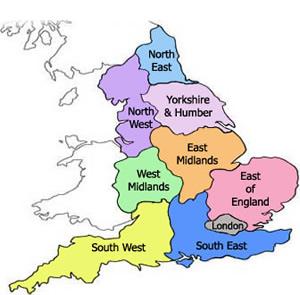
With an area of just over 50,000 square miles (130,000 sq km) and densely-populated with 53 million people, an average of just over one million per 1,000 square miles, England is divided into nine regions, as shown above. Each has different concentrations of Russian Orthodox inhabitants, but London above all and then the two regions nearest London have the largest concentrations. We would suggest that there should generally be one church, of varying size, for each catchment area of around one million people, given that the local Russian Orthodox population, however irregularly practising, is on average about one in a thousand. This would create potential parishes of around 1,000, although numbers attending on an average Sunday might only be 100-200.

Obviously, the concentration of Russian Orthodox population varies immensely, being highest in London, average in the towns of the South and East, and lowest in the rural areas of the North and the West. Therefore larger churches in Greater London and other very large cities would have very small catchment areas of perhaps only 50 square miles, whereas in the provinces smaller churches might cover between 500 and 2,500 square miles, on average about 1,500 square miles, depending on how rural the surrounding area is.

As can be seen below, there are exactly fifty cities and towns in England with populations of over 100,000. Logically, it is most of these centres of population which should be targeted to establish churches. It is true that a few of these cities and towns already have permanent, public-access, multinational Russian Orthodox churches, although four of these have been established only in very recent years. Notably, this is the case in London, although the parishes there are totally insufficient in number, with only two, one medium and one small, for an urban area population of over 11,000,000. Outside London a few cities and towns have become relatively better equipped – for example, Manchester, Liverpool/Birkenhead, Oxford and Colchester, although there is more to be done even here.

City City Population Urban Area Population
London 7,393,800 11,230,500
Birmingham 985,900 3,202,800
Liverpool 466,600 3,630,100
Sheffield 421,800 1,104,900
Leeds 420,300 1,498,500
Bristol 409,300 614,800
Manchester 394,300 394,300
Leicester 319,100 319,100
Kingston on Hull 309,100 309,100
Coventry 295,000 411,200
Bradford 290,400 290,400
Nottingham 271,400 632,300
Stoke-on-Trent 266,700 266,700
Wolverhampton 258,100 258,100
Plymouth 249,900 249,900
Derby 227,900 227,900
Reading 222,700 222,700
Southampton 211,500 733,600
Newcastle on Tyne 187,200 1,147,200
Preston 183,400 183,400
Sunderland 180,700 180,700
Luton 179,700 179,700
Portsmouth 176,300 176,300
Norwich 173,300 173,300
Bournemouth 161,800 161,800
Southend on Sea 160,900 160,900
Swindon 153,700 153,700
Blackpool 147,500 147,500
Poole 146,000 146,000
Middlesbrough 144,800 692,500
Peterborough 144,800 144,800
Huddersfield 143,500 143,500
Bolton 138,400 138,400
Stockport 133,000 133,000
Ipswich 131,400 131,400
York 126,200 126,200
Brighton 122,500 122,500
Rotherham 122,000 122,000
Oxford 121,700 121,700
Gloucester 117,900 117,900
Watford 115,400 115,400
Slough 113,300 113,300
Blackburn 105,600 105,600
Basildon 104,600 104,600
Saint Helens 104,400 104,400
Northampton 104,100 104,100
Oldham 103,700 103,700
Woking-Byfleet 102,800 102,800
Chelmsford 100,700 100,700
Colchester 100,300 100,300


In general, we would suggest that where towns of 100,000 + are near one another, only one permanent church is necessary. For example, from the above list: Sunderland is next to Newcastle; Blackburn and Blackpool are next to Preston; Bolton, Oldham and Stockport are next to Manchester; Rotherham is next to Sheffield; Huddersfield and Bradford are next to Leeds; St Helens is next to Liverpool; Derby is next to Nottingham; Wolverhampton is next to Birmingham; Ipswich, Chelmsford and Southend-on-Sea are next to Colchester; Reading is near Oxford; Basildon, Watford, Woking-Byfleet and Slough would come under London urban area parishes; Portsmouth is next to Southampton, Bournemouth is next to Poole. Only one of these towns need have a church.

Nevertheless, if we were able to plan to provide cover for most of England with permanent, public-access, multinational churches, faithful to the Russian Orthodox Church and calendar, then we would need: in London nine more churches; in Birmingham three churches; in Liverpool two more churches (as there is already one in nearby Birkenhead); one church in each of Sheffield, Leeds, Bristol, Leicester, Hull, Coventry, Nottingham, Stoke, Plymouth, Southampton, Newcastle, Preston, Norwich, Bournemouth, Swindon, Middlesbrough, Peterborough, York, Brighton, Gloucester, Luton (St Albans) and Northampton.

According to the above, we are suggesting the obtaining or building of no fewer than 36 more churches, in addition to the five already established. The aim of this path is to ensure that the Russian Orthodox Church and its liturgical calendar are permanently accessible to the interested population in England, in English and Slavonic. However, even such a minimal schema of establishing a church, whether large or small according to local needs, for about every one million people in the main local centres of population, so that most should not have to travel more than 25 miles in a straight line (so in fact further, as one cannot travel in straight lines) to get to church, means that areas with several towns, but all with populations fewer than 100,000 and relatively more rural areas have been omitted.

For example, even in the above schema there is, surprisingly, no church in Kent, the south-west outside Plymouth, Herefordshire, Worcestershire, Shropshire, Lincolnshire, Northumberland and Cumbria. Therefore, it would also seem sensible to hope to establish 13 other churches or monastic pilgrimage centres, perhaps in: Canterbury, Exeter, Barnstaple, Truro, Hereford, Worcester, Shrewsbury, Lincoln, Lindisfarne, Carlisle, as well as in Newport in the Isle of Wight, in Douglas in the Isle of Man and in the Channel Islands. This would mean a total of 54 churches in England and altogether 70 churches for the Russian Orthodox portion of the 68 million in the British Isles and Ireland.

Locally: The East of England

What of the Patriarchal vision locally? The East of England is in area the second largest of the nine English regions. It covers the six counties of Norfolk, Suffolk, Essex, Cambridgeshire, Bedfordshire and Hertfordshire. The regional population at the 2011 census was 5,847,000, 11% of the total population of England, making this an ‘average’ region. The largest towns are Luton, Basildon, Peterborough, Southend-on-Sea, Norwich, Ipswich, Cambridge, Chelmsford and Colchester. This region has an average number of Russian Orthodox, because it is near London and also because it faces Eastern Europe, especially the Baltic States, from where many have come. Therefore, with a population touching six million, though with many in Essex and Hertfordshire living in the Greater London urban area, the region should have five church centres, of which today only one exists.

At present the East of England Orthodox Church (EEOC – a charitable trust) is set up in Colchester (population: 104,390). This trust is the owner of the only permanent, Russian-speaking and English-speaking church in the region which is in Colchester. At present this covers not only its natural catchment area of Essex outside London and Suffolk, but much of the region and even beyond. This natural catchment area of some one and a half million includes Southend-on-Sea (174,300), Ipswich (133,384), where we are helping a new Russian Orthodox mission, Chelmsford (120,000) and several smaller towns like Clacton, near where there is now also a mission, Braintree, Witham, Sudbury and Felixstowe, from where this whole East of England mission began. The local saints are: St Helen, St Botolph, St Cedd, St Osyth, St Edmund.

However, at the present time, because of the lack of permanent Russian-speaking and English-speaking centres faithful to the Russian Orthodox Tradition and calendar in the region, our flock is drawn from all over the East of England. On occasion it even comes from outside it, from London, the South East and the East Midlands. Therefore, if God wills and if there are faithful who wish this and can make the necessary sacrifices, we should be looking to setting up other permanent, Russian-speaking and English-speaking centres, faithful to the Russian Orthodox Tradition and calendar. Initially, we would suggest a minimum of four other centres of population as possible locations in addition to Colchester, perhaps as follows:

1. Norwich (173,300). The natural catchment area of about one million covers most of Norfolk and North Suffolk, includes Great Yarmouth (68,317), Lowestoft (64,358), Thetford (21,588) and smaller towns. This area has been our priority for several years, so far without success, with parishioners travelling to us from Norwich every weekend. Local saints: St Walstan, St Edmund, St Felix. Given the very many medieval churches and dedications in this city, perhaps the church could be dedicated to All Saints.

2. Peterborough (144,800). Although just inside Cambridgeshire, the natural catchment area covers towns outside the East of England region, including Boston (58,124), King’s Lynn (42,800), Spalding (28,722) and Wisbech (20,200). Although this catchment area is small, it has a high proportion of Russian Orthodox immigrants from Eastern Europe and especially the Baltic States and it must be a priority. Local saints: St Peter, St Paul, St Guthlac, St Huna, St Wendreda, Martyrs of Crowland. Given the city’s name, the church should be dedicated to Sts Peter and Paul.

3. St Albans (58,000). Although this is a small town near the much larger Watford and Luton, it would seem only right for historic reasons that a church centre be established precisely here, in the city of the first martyr of the British Isles and dedicated to him. The natural catchment area of some one and a half million covers most of Bedfordshire to the north, Hertfordshire outside London to the south and even the west of Essex. Just to the north of London, it is surrounded by other towns, both larger and smaller. These include: Luton (179,700), Watford (115,499), Harlow (94,365), Stevenage (84,651), Hemel Hempstead (81,143), Bedford (79,190) and several smaller towns. (Watford and Hemel Hempstead are officially included in the Greater London urban area). Local saint: St Alban. The church should be dedicated to St Alban and built in a Roman style and roofed with pantiles, as was the church in Silchester.

4. Cambridge (123,900). The catchment area includes smaller towns in Cambridgeshire, west Suffolk and north-west Essex like Bury St Edmunds (35,015), Haverhill (25,000), Huntingdon (19,830), Newmarket, Saffron Walden and Ely. Although this is a smaller catchment area, it is important because of the very high numbers of Russians at the University of Cambridge. (There are over 1,000 members of the Cambridge Russian Club and over 200 children at the Russian School). Local saints: St Audrey, St Neot, St Ives, St Pandwyna. Given the University here, perhaps the church could be dedicated to the Three Hierarchs.

Colchester and these four towns actually form a cross drawn over the East of England. It is true that there are already other Orthodox groups and missions in the East of England, either using temporary/Anglican premises or else domestic chapels. However, most of these are not Russian Orthodox or exclude those who live by the Church calendar, and all generally cater for only one nationality or national sub-group, for instance, Greek, Romanian or ex-Anglican. In any case, none is permanent and public-access and caters for the multinational, Russian-speaking and English-speaking Russian Orthodox Tradition and calendar. However, all of these chapels and structures play their role too in regional Orthodox life, by looking after individual national groups, whether larger groups from Eastern Europe or small convert chapels with ex-Anglicans. If some would like, on a purely voluntary basis, to join in the above scheme for a local Orthodoxy, all the time remaining in their Mother Churches, obviously that would be welcome.

Conclusion

As an example of a diocese of the future Metropolia, we have taken the British Isles and Ireland, but have focused on that part of the diocese where most Russian Orthodox are concentrated – England. From here we have focused on one region, as a kind of case study – the East of England. We have suggested that in England regional church centres should be established to cover about every one million people, meaning that ideally 54 churches should be established if the needs of the multinational Russian Orthodox population are to be met. At present there are only five such churches – only about one tenth of our initial work has been done.

The fact that we can even discuss such a vision shows, however, a remarkable shift from even a few years ago, when such a thing would have been unimaginable. Of course, these are still abstract propositions, set out only to stimulate thought. In reality, all will depend on the existence of this Metropolia, its infrastructure and suitable personnel, and also on where locally the multinational Russian Orthodox population is concentrated and on its needs, abilities and willingness, both financial ability and, above all, the human willingness to make sacrifices for the Church. We need adequate infrastructure, not only Church buildings, but also Church halls and rooms with toilets, kitchen and car parking, accommodation for clergy and choir directors and investment to provide salaries; but above all, we need people who have faith and want churches.

Some will dismiss all the above suggestions for a Western European Metropolia as fantasy. But given that many large towns and cities in Western Europe already have churches, some of these churches even built in the 19th century, or at least communities, we are talking of perhaps one billion euros to establish this Metropolia of 400 churches. This is an impossibly huge sum for us, but a small sum for a Russian oligarch – for example. Churches come into being through the grace of the Holy Spirit inspiring human motivation, faith. It is true that if there is no faith to be inspired, then there is no hope, for hope is always the result of faith. It is true that all ‘plans’ are therefore only abstract. And realities can often turn out to be very different from our hopes, which have to be blessed in order to become reality. As ever: man proposes, but God disposes.

Appendix

Possible Dedications for Russian Orthodox Churches in the British Isles and Ireland

England

Already existing:

London: The Dormition and All Saints / The Dormition and The Royal Martyrs
Oxford: St Nicholas
Birkenhead: St Elizabeth the Grand Duchess
Manchester: The Protecting Veil
Colchester: St John the Wonderworker / All Saints of the Isles

New

Barnstaple: St Morwenna
Birmingham (3): The Exaltation of the Cross, All Saints of the Isles, St Seraphim of Sarov
Bournemouth: St Edward the Martyr
Brighton: St Andrew the Apostle
Bristol: St Nicholas
Cambridge: Three Hierarchs
Canterbury: Christ the Saviour
Carlisle: St Ninian
Coventry: The Transfiguration
Douglas (Isle of Man): St Maughold
Exeter: St Boniface
Gloucester: All Saints
Hereford: St Ethelbert
Hull: St Hilda
Leeds: The Baptism of the Lord
Leicester: St Thomas the Apostle
Lincoln: St Paulinus
Lindisfarne: St Cuthbert
Liverpool (2): The Baptism of the Lord, St Nicholas
London (9): Holy Trinity, The Resurrection, The Nativity of Christ, Sts Peter and Paul, St Pancras, St George, St Augustine of Canterbury, St Edmund, All the Saints of the Isles
Middlesborough: St Bede the Venerable
Newcastle: St Aidan
Newport (Isle of Wight): St Boniface
Northampton: St Michael the Archangel
Norwich: All Saints
Nottingham: St John the Theologian
Peterborough: Sts Peter and Paul
Plymouth: St John the Baptist
Preston: St John Chrysostom
St Albans: St Alban
Saint Helier: St Helier
Sheffield: The Ascension
Shrewsbury: St Winifred
Southampton: Sts Peter and Paul
Stoke on Trent: The Meeting of Christ
Swindon: The Resurrection and St Alfred
Truro: St Michael the Archangel
Worcester: The Annunciation
York: Sts Constantine and Helen

Scotland

Aberdeen: Sts Peter and Paul
Dundee: St Nicholas
Edinburgh: St Andrew the Apostle
Glasgow: St Kentigern
Inverness: The Resurrection
Iona: St Columba

Ireland
Belfast: The Transfiguration
Cork: St Finbar
Derry: The Resurrection
Dublin: St Patrick
Galway: St Brendan the Voyager
Waterford: St Brigid

Wales
Aberystwyth: St David
Bangor: St Deiniol
Cardiff: St Nicholas
Swansea: The Resurrection and Sts Julius and Aaron

What Can Each Western European Land and People Bring to the Church?

In Central and Eastern Europe, each land and people can learn of Orthodoxy from both its history and its present neighbours, so bringing its particular genius to the Church of God. Thus, from north to south:

Finland learns Orthodoxy from neighbouring Russian Karelia and its saints like St Tryphon of Pechenga, Enlightener of Lappland (+ 1583).

Poland learns its Orthodoxy from Mieszko I, baptized from Moravia in 966, and today learns from Belarus, the Ukraine and its native Lemko Carpatho-Russians.

Slovakia learns its Orthodoxy from Sts Cyril and St Methodius, as well as from the Carpatho-Russians, both native and in neighbouring Transcarpathia.

The Czech Lands learn from the glorious heritage of St Rastislav and Sts Cyril and Methodius in Moravia, St Ludmila and St Viacheslav in Prague, and learn from the struggles of Jan Hus in Bohemia.

Hungary learns from the ancient heritage of its first Christians, come from New Rome with Bishop Hierotheos in c. 950, as well as from its Orthodox neighbours.

Slovenia and Croatia learn from the first Slav missions of Sts Cyril and Methodius and their disciples.

But what of the Western European lands, which, although they have a glorious but distant Orthodox past, have no Orthodox neighbours and so have to learn from new immigrant populations? What can they bring?

The German Lands, Germany, Austria and most of Switzerland, can bring order and discipline. It is no coincidence that the first liturgical book translated into German was the Typicon.

The French Lands, France, southern Belgium and eastern Switzerland, can bring the contemplation of God, the philosophy of faith.

England and the Celtic Lands, Ireland, Scotland and Wales, can bring asceticism. It is no coincidence that the first liturgical book translated into English was the Lenten Triodion.

Italy, that storehouse of Church relics, can bring the sense of Church history as the historic centre of Orthodoxy in the West.

Spain and Portugal can bring their sense of beauty, ritual and vestments.

The Dutch Lands, the Netherlands, Flanders and Luxembourg, can bring co-operation and co-ordination.

Scandinavia, Sweden, Denmark, Norway and Iceland, can bring efficiency and practical effectiveness.

If a Russian Orthodox Metropolia is to come into existence in Western Europe, we can then suggest how each of its lands and peoples can contribute their history from the first millennium and also their qualities as they developed in the second millennium.

The Ten Commandments and the DeChristianisation of the Western World

About 1300 years before the birth of Christ – nobody now knows exactly when – Moses received from God the Ten Commandments, or Decalogue, which provided a radical new basis for all human civilisation, life and morality. These Commandments were fulfilled and supplemented, but in no way rejected, by Christ in the Beatitudes. The Ten Commandments are expressed in the following simple form:

1. Thou shalt have no other Gods but me.
2. Thou shalt not make for thyself any idol, nor bow down to it or worship it.
3. Thou shalt not take the name of the Lord thy God in vain.
4. Thou shalt remember the Sabbath day, to keep it holy.
5. Honour thy father and thy mother.
6. Thou shalt not murder.
7. Thou shalt not commit adultery.
8. Thou shalt not steal.
9. Thou shalt not bear false witness against thy neighbour.
10. Thou shalt not covet thy neighbour’s goods.

During the first millennium after the birth of Christ, Western Europe was gradually Christianised, steadily submitting to the Ten Commandments in their natural order, from first to tenth. The Commandments were brought to it by the Church from Jerusalem, centred in Her Capital of New Rome (later called Constantinople), its double-headed eagle uniting east and west, Asia and Europe.

However, Western paganism, formed by a complex mixture of pagan Romanism and pagan Germanism, began to take over Western Europe. This process took place in an ever accelerating way, so that in the ten centuries of the second millennium after the birth of Christ, Western Europe rejected each of these Commandments in reverse order, in this way reversing its Christianisation.

This process took place in reverse order because the last Commandment to have been implemented had had the least time to become rooted in Western European society. Therefore, it was challenged and overturned more easily than the earlier Commandments which were better rooted. Thus, throughout the ten centuries of this second millennium, each Commandment was rejected in turn.

In the eleventh century, the covetous Crusades in the Iberian Peninsula, in Sicily, England and then the Middle East and the Holy Land, marked the systematic and institutional beginning of imperialist greed and colonisation, with Western Europe covetously ravaging and pillaging its neighbours.

In the twelfth century, filioquists bore false witness, asserting that the Church had omitted the filioque from the Creed!

In the thirteenth century, in 1204 the Christian Capital of New Rome was looted, its shrines, relics and artefacts stolen as were many other Christian towns and cities.

In the fourteenth century, the ‘Church’ of Western Europe committed adultery with State values, its vestigial Christianity being made subject to a State-like authority, so becoming a ‘Church-State’.

In the fifteenth century, Western Europe began its murder of the peoples of the New World in unspeakable genocides, thus bringing them ‘Western civilisation’, ‘freedom and democracy’.

In the sixteenth century, Western Europe dishonoured its father and mother by rejecting many of the remaining vestiges of the Orthodox Faith by falling into Protestantism.

In the seventeenth century the Western world dishonoured holiness through its iconoclasm.

In the eighteenth century, the Western Enlightenment took God’s name in vain, rejecting the Revelation of God the Holy Trinity, preaching man-hating deism and then atheism in violent wars and revolutions.

In the nineteenth century, the ethnocentric Western world made an idol of itself, idolising its newly acquired knowledge of the fallen world (‘science’) in a cruel industrial revolution, idolising its all-limiting rationalism in a multitude of theories that despised God and exploited man.

In the twentieth century, the Western world rejected God and instead made gods of everything, inventing every ism, so beginning its suicide in World Wars and giving itself the ability to destroy every living thing on the Earth many times over.

If, one by one, the Ten Commandments were rejected in the Western world, century by century during the second millennium, what then can be said of the twenty-first century, of the third millennium?

Only this – that the Western world is living on borrowed time.

The Final Delusion

One of the oldest standard atheist cliches is that religion causes all wars and strife in the world. As the Jewish-American left-winger Tom Lehrer sang nearly fifty years ago:

Oh, the Protestants hate the Catholics
And the Catholics hate the Protestants
And the Hindus hate the Moslems
And everybody hates the Jews.

A generation later, his words were echoed by another anti-religious left-wing singer, John Lennon:

Imagine there’s no heaven
It’s easy if you try
No hell below us
Above us only sky
Imagine all the people living for today.

Imagine there’s no countries
It isn’t hard to do
Nothing to kill or die for
And no religion too
Imagine all the people living life in peace.

Of course, none of this true. In reality, to paraphrase Dr Johnson (1709-84), religion, and not patriotism, is ‘the last refuge of the scoundrel’. Scoundrels do not justify their hatred, envy, malice, cruelty and lust for wealth, territory and power by announcing truthfully that they are hateful, envious, malicious, cruel and lustful for wealth, territory and power, they camouflage it behind the noblest human instincts. Religion, the noblest, is therefore their flag, their best excuse, although ‘patriotism’ or ‘freedom and democracy’ will do, whenever atheistic and secularist societies want to justify their evil aggression and massacres.

However, interestingly, in the Gospels Christ does not ask if on His return, He will find religion on earth, rather He asks if He will ‘find faith on earth’ (Lk 18, 8). For religion means a humanised, institutionalised, thisworldly system, adapted to the demands of states. It is a State-manipulated substitute for real faith and it may well abound when Christ returns. On the other hand, faith is the Holy Spirit living and acting in the hearts of the faithful, and that will be very rare when Christ returns, if it exists at all.

And this is what Tom Lehrer’s song and John Lennon’s songs are about. We can see it very clearly in the present war in Syria, where ethnic groups hide behind their religious name tags. Daily we hear of Sunnis, Shiites, Alawites, Druze and Christians, all fighting and slaughtering one another. It is the same in Burma (Buddhists versus Muslims), in Northern Ireland (Protestants versus Catholics), in Nigeria (Muslims versus Christians), and in almost every other conflict in the world, present, past and future.

So are Tom Lehrer, his follower John Lennon and the standard atheist, right when they imply that religion is the cause of war?

Of course, they are not right. It is human evil that causes war, though very, very often it cloaks itself in ‘religion’ – but never in faith. Faith, the knowledge of spiritual reality (not institutionalised or nationalised ‘religion’), is the cause of peace, not of war.

However, such subtlety is lost on the atheistic mass media, which always present human conflicts as caused by ‘religion’, despite all the obvious cases when it is caused by anti-religious atheists – like Napoleon, Lenin, Hitler, Stalin, Mao and any number of other tyrants. The mass media always present wars as ‘religious wars’, ‘wars about religion’, and not about ethnic identities fighting for wealth, territory, natural resources and power.

And this is how, surely, the end will come. Some ‘great’ man will appear as a peacemaker and unite, i.e. destroy, all religions and settle in Jerusalem, not far from Syria, where deluded people will bow down before him and all his magic tricks and illusions. Peace will come for a short time – but at the cost of freedom, and Antichrist, the Grand Inquisitor, as Dostoyevsky foretold, will triumph from his throne. No religion, no heaven, no hell, just imagine – ‘it’s easy if you try’, ‘all the people living for today’. We have seen so many of Antichrist’s little forerunners, from Charlemagne to Napoleon, from Hitler and even the deluded imagination of John Lennon, that we know the story of the end. Let us then beware.