Category Archives: Orthodoxy

Resisting Globalisation

new world order

The Life of Christ, Orthodoxy, witnessed three horrible deaths:

Firstly, there was the death of Herod. He who through lust had instituted physical and economic slavery was eaten by worms from inside.

Secondly, there was the suicide of Pilate. He who through cowardice had instituted intellectual and political slavery did away with himself.

Thirdly, there was the suicide of Judas. He who through greed had instituted spiritual and religious slavery, who had replaced the worship of life and the living by the worship of death and the dead, hanged himself and his guts spilled out in his fall.

These three deaths are also the deaths that are necessary if all Christian nation states and legitimate hierarchies are to be liquidated in order to enthrone Antichrist:

Firstly, monarchies had to be destroyed by physical revolutions so that Herod can take control: the English Protestant in 1688; the French Catholic in 1789; the Russian Orthodox in 1917.

Secondly, national sovereignty has had to be destroyed by intellectual revolutions so that Pilate can take control; this means transnational organisations: UN; NATO; IMF; WTO; EU; NAFTA etc

Thirdly, a unipolar Global Empire must be constructed by religious revolutions so that Judas can take control; this means what we are seeing at this very moment, with his capital planned in Jerusalem.

This globalisation, the new feudalisation, the movement towards a unipolar world against a multipolar world, the syncretistic, unionistic movement to prepare the enthronement of Antichrist in Jerusalem, can only be resisted by a united Orthodox Christian Empire. It is time to see visible Orthodox Unity under the Third Rome and Second Jerusalem. Local Churches, fallen into decadent practices, have to remove themselves from their political and spiritual manipulation, from nationalism, protestantisation, vaticantwo-isation, secularisation and modernisation, by spiritual renewal and so movement towards spiritual purity.

With the mighty Russian Orthodox Church, paralysed by its Babylonian captivity and Golgotha, and so absent from the world scene for three generations between 1917 and the 1980s, the manipulated modernist and pro-secular forces on the fringes of and even in the midst of the Local Churches fell into this decadence. Since the canonisation of the New Martyrs and Confessors, these forces have largely been defeated by the resurrection of the Russian Church, so long awaited and so long prayed for by lonely White Orthodox exiles outside Russia and, in spiritual unity with them, by the people, monastics and faithful clergy of the Church inside Russia.

All is beginning to change as a result and now, whether in the first-fallen Phanar or in Alexandria, Bucharest, Antioch, Athens, Nicosia, Prague, Sofia, Warsaw, and also in sorely tempted Belgrade, Jerusalem, Tbilisi and Tirana, even some repentant secularists are beginning to realise that the choice is clear. It is either the pagan First Rome, the false globalist US/EU path they have already taken or are being bribed into taking, or else the multinational but united Orthodox path of resistance set by the Christian Third Rome, the Second Jerusalem. The resurrection of the Orthodox Empire and Monarchy is now the only path that can and does lead to freedom from global slavery, the only path that can and does lead from death to life, from Judas to Christ.

The Blue Lady of Sycamore Hill

By Alvin Alexsi Currier (Available from Amazon at £5.99 in the UK)

This is a little book, published in the USA, with just 28 pages. You might think it expensive, but it is not, because this is the most Orthodox book of this year. And it will make you weep.

It tells the story of the Appearance of the Mother of God to four young Orthodox women in southern Poland in 1925. It is full of the most delightful, childlike pictures. The text also is ultra simple. But it is worth far more than all the learned tomes of ‘theology’ produced at universities and talks given at ‘conferences’. Unlike them, this book will not send you to sleep.

This book is first of all a tribute to the Carpatho-Russian people of south-east Poland, known as ‘Lemkos’. It is a tribute to their suffering under the cruel Catholic Austro-Hungarian Empire, then under Fascist Poland that in turn was swept away by Nazi Germany and Soviet Communism. It therefore has a universal significance for all real Orthodox, because we all face the same devilish, this-worldly tribulations to survive anywhere, especially those of us who have been called to live in the Western world.

As the gifted author, who writes from the heart, says: ‘The Latin literacy of the West gave birth to a church rich in learning, piety and art. However, our mostly illiterate Eastern Orthodox ancestors painted, sang and acted out the Gospel, weaving it through a rich, liturgical cycle, wrapping it in a vibrant folk culture and celebrating it in their amazing churches. Our faith more than anything else is the mark of our people’.

These words are true not only for the Carpatho-Russian Lemkos, but for all of us who are destined to be Orthodox of all nationalities the world over. Put away your dusty monographs and heavy tomes! Come down from your ivory towers! Taste of the sweetness of Orthodox Christian LIFE! All 220 million Orthodox Christians of every race and clime the world over, hearken to the words of the Most Holy Mother of God on Sycamore Hill, words of revelation to us all this very day:

‘Our compassion embraces you. Here I will make a home among you. Here I will be one of you and you shall be mine. Ahead lay rivers of tears and valleys of pain. You shall tread the edge of the abyss of despair, but here a spring shall flow, to nurture your return to the love and beauty that is your heritage and destiny’.

The Odour of the Apocalypse

Tsar Nicholas III, in a recent speech in St Petersburg, called for the right of all sovereign peoples to determine their own futures without outside interference…Imperial Russian Armies have now crossed the Caucasus and are heading in a two-pronged attack towards Constantinople and through Turkey and Syria towards Jerusalem.

From It’s Later than You Think, July 1991, from Orthodox Christianity and the English Tradition

Introduction

Yesterday’s bombing in Boston was appalling and evil. Innocent bystanders, children included, were killed or maimed. However, there are events going on in the world today that are worse even than this. The difference is that those events are hardly reported by the Western media, which often appear to have little but contempt for those who are not included in its ethnocentric navel-gazing.

The Middle

Yesterday’s bomb in Boston is what Iraqis have had to put up with, only on a far worse scale, every few days for the last ten years. A million or more are dead, their country ravaged and in part destroyed, families maimed and killed, even water, gas and electricity in this once rich country are not available all the time. Sometimes, in this oil-rich land, no petrol can be had for cars. The result is that all who can are getting out and that half of Iraq’s almost bimillennial Christians are living in refugee camps and in exile, their lives ruined by a thoughtless and selfish invasion and occupation, which has brought little but misery.

Then there is the war in Syria, largely an invasion being waged by foreign mercenaries against the Syrian people on behalf of powers playing a great geostrategic game to divide and rule the Middle East, whose centre is in Jerusalem. Tunisia, Libya and Egypt have already been destabilised by those powers, their Christian inhabitants the first victims. The terrorists in Syria are fanatical Islamists, their ideology invented by the CIA. They are financed and armed by Afghan drug money, greatly increased since the invasion of Afghanistan, and by the despotic but oil-rich, feudal Islamist monarchies of the Gulf.

These have airlifted in thousands of tons of arms, mainly from Croatia and the Ukraine, to the terrorists who are being trained by US, UK and French Special Forces in the Jordan and Turkey. At stake are the huge untapped gasfields in the Eastern Mediterranean and pipeline routes to Europe. Turkey, for long a puppet, but once the centre of the Ottoman Empire, eyes territory and reserves. The Lebanon quakes, fearing the spillover into its territory. Israel hopes but trembles, seeing opportunities but also threats. The victims are the millions of Christians and other minorities, who mostly live in and around Damascus, Aleppo and Homs.

The West

Meanwhile, the Western world is riven by the problems which it created in 1917, when it exported an ideology of hatred to destroy the Russian Empire, the sole remaining bastion of the Orthodox Christian world, the Orthosphere. Since the fall of that Christian Empire, the world has known only instability. Over the last ninety years, the West has attempted to destroy the soft underbelly of the Orthosphere, installing its candidates as Patriarchs of Constantinople and attempting to undermine the other Greek Patriarchates in Antioch, Alexandria, Jerusalem and Local Churches in Greece, Cyprus, Romania and Bulgaria.

In the last twenty years the Western world, directed from Washington or from its puppet in Brussels, has tried to further undermine those and other parts of the Orthosphere. First, it attacked Bosnia, Serbia, Macedonia, Montenegro and Kosovo in a divide and rule policy, bombing Belgrade for Easter, deforming Serbian babies with ‘uranium-enriched’ warheads in Nazi atrocities. Then, having bribed Greece to join the EU, it bribed Cyprus, Romania, Bulgaria and the Baltic States, so bankrupting them. Finally, the West set about destabilising the Ukraine, Georgia, Syria and, last year, the final bulwark, the Russian Federation.

Western people are many-layered. In order for them to rebecome Christian, they have to remove every layer of their anti-Christian culture, which they deludedly imagine to be Christian. The layer of modern secularism has to go, then that of 19th century imperialism and rationalism (in fact anti-rationalism), then the darkness of the ‘Enlightenment’, then the protest of the Reformation (as if you could understand the Scriptures without the Holy Spirit), next feudalism, scholasticism and the crusades all have to be removed. Sadly, few are able to cleanse themselves of all the delusions of these layers of proud cultural prejudice.

The East

At the other end of Asia to the physically and spiritually bankrupt ‘Judeo-Christian’ West, there is the East. Today, this means the threat from North Korea, a gigantic Stalinist concentration camp, ruled by madmen, who appear to have nuclear weapons, like India, Pakistan, Israel and perhaps Iran. Yet, it is doubtful if this North Korea could exist without Capitalist-Communist China, which is so hard-working and therefore so rich that it also owns much of the Western world. Yet, paradoxically, it may be that it is this part of Asia which may bring solutions to the current world crisis of this time before Antichrist.

Two prophecies tell us that salvation will come from the East. St John of Kronstadt (+ 1908) prophesied that the deliverance of Russia would come from the East and, ten years later, St Aristocleus (+ 1918) prophesied that the real end of Russia’s errings would come through China. And errings there are. In Russia, which stretches from the East to the West and whose canonical Church territory includes China, current dissatisfaction is real and exists because of ingrained and systemic corruption. It is this dissatisfaction, in itself justified, which is so easily exploited by the dark forces of the West which seek to destroy Russia.

If we are worthy of these prophecies, Russia will be restored and with it the rest of the Orthosphere, which for now is captive to German economic power (able even to steal from private bank accounts) and American military power (able even to steal from private computer accounts). If we are worthy of these prophecies, we may yet also be able to gather together the remnants of the peoples of the whole world into the Church before the end. If we are worthy of these prophecies, it may be that the peoples of the East and West will be reunited once more, not by Babylon, but by Jerusalem.

Conclusion

The Christian Russian Empire, heir to the Christian Roman Empire, was crucified in its Golgotha of 1917. After three ‘days’ (generations) it rose from the dead. The giant is now beginning to speak to the world, East and West alike, of the Resurrection and what it saw when it went down to hades. Will the world, seemingly unaware of this odour of the Apocalypse, listen? We can only pray.

Note:

1. In 1973 the Abbess of the Convent at Gethsemane, Mother Barbara (Tsvetkova) spoke of the prophecy of Elder (now St) Aristocleus of Athos (1838-1918), who was then living in Moscow. The Elder told the future Abbess, then a young student, that ‘regeneration in Russia will begin after a most powerful explosion on the bank of a big river’. When in 1986 the atomic catastrophe occurred at Chernobyl, this prophecy came true.

English-Language Island Orthodoxy

Introduction

Seven of the fourteen universally recognised Local Orthodox Churches are represented in the Diaspora and therefore in the British Isles. The Local Churches present are: the Russian with two dioceses – the Sourozh Diocese, directly dependent on Moscow, and the Diocese of the self-governing Church Outside Russia, known as ROCOR; the Greek Thyateira diocese, under the Church of Constantinople; the Antiochian deanery; the Serbian; the Romanian; the Bulgarian; the Georgian. However, the last four dioceses, though witnessing to a venerable Orthodox Tradition, are not relevant to our consideration here, as we are concerned with parishes which make extensive use of English. What then is the situation of the first four groups today, with regard to their use of the English language in services?

The Sourozh Diocese

The Sourozh Diocese, founded in 1962, originally consisted of only two tiny parishes, because 90% of exiled Russians saw it as a Soviet institution and deeply mistrusted it. In order to exist as a diocese, however small, it therefore had to recruit members among Anglicans – hence its need to use English. The difficulty with this was that Sourozh, based around a personality rather than the Tradition of the Church, often failed to integrate these Anglicans into the Church, receiving them very swiftly. The result was that many of the faithful Orthodox, either Russian or else English, but Non-Anglican, left Sourozh, or rather were forced to leave it. The modernistic, new calendarist ethos being promulgated by the Anglican newcomers was alien to those who knew the Tradition.

Being based around a single divisive personality, Sourozh therefore never had a real diocesan structure and premises outside London and, just, Oxford; this today is yet another bitter fruit of its past legacy, which is not yet buried. For the same reason, once the personality had died (as all personalities do), a schism took place. For decades, the followers of the personality cult had ejected actual Russian Orthodox, because the former were a majority imposing their politically-minded Orthodoxy on the minority. However, once Russian Orthodox had become the majority through immigration, the old majority of 300 decided to leave. This was in 2006. Reality had caught up with fantasy and political Anglican-Orthodox syncretism could only continue outside the reunited and restored Russian Tradition and Church discipline.

Of course, they were free to leave. No-one would have minded that. The error of its leaders was to try and take away Church property and the Russian Orthodox name with them. For, as is clear with the example of those centred in Paris who also left the Russian Church in order to create a modernist ideology, you can only be Russian Orthodox if you are faithful to the Russian Orthodox Church. After the 300 had left, diplomacy was required. Nevertheless, even a diplomat of foreign culture with some English can misunderstand English people. Misunderstandings are inevitable. Today, the future direction of Sourozh is not clear, other than that it will, in time, merge with the ROCOR Diocese as part of the future Western European Metropolia, one of probably three in the future ROCOR.

The ROCOR Diocese

In the 1950s the ROCOR Diocese, with a bishop living in Preston and a saintly archbishop on the Continent, had been second only to the Thyateira Diocese in size. However, within a generation it had gone from big to small. Even in the early 1980s its London Cathedral was still attended by some 400 every Sunday (600 in the 1960s). But they were nearly all elderly. Insisting on Russian ethnicity and language, ROCOR lost the young and parishes closed one after the other. Within a few years ROCOR was to lose its bishop, its clergy (who went to North America or Western Europe), its Cathedral and most of its diocese. Greek old calendarism appeared with an Anglo-Catholic tint. Many in the 1990s thought that the local ROCOR Diocese would die out completely; however, in recent years there has been a revival.

Nevertheless, ROCOR’s great weakness is the lack of a resident bishop. The problem here is that the Diocese is now too small and poor to have a bishop; but this is a vicious circle; it only became small and poor because there was no bishop in good health or resident. This may be called ‘the South American syndrome’, where in a similar situation, action was also taken too late. A uniting, bilingual (and bicultural) bishop would be the solution, especially as the Sourozh Diocese is to merge into the ROCOR Diocese. Such a figure is also necessary, for if the situation in Russia were to degenerate and, for example, some pro-Western regime came to power there and began to persecute the Church, as happened in Constantinople, the self-governing Church Outside Russia (ROCOR) would have nothing to fear.

The Thyateira Diocese

Under the Patriarchate of Constantinople, the Thyateira Diocese has been the largest of the Local Churches present in the British Isles and Ireland ever since post-War immigration from Commonwealth Cyprus. However, its situation is now increasingly similar to that of ROCOR about forty years ago. Many of its parishes are dying, attended by the elderly. The young have been lost because of the insistence on ethnic identity and the Greek language. Thus the Anglican Diocese of London has for instance six priests of Greek background. Not speaking Greek, but only English, they felt no identity with the ‘Greek’ Church. And even educated young people, who remained faithful to Greek Orthodoxy, have left for the Greek Church in USA, where they are not reprimanded for using English.

Within this Diocese there are a small number of ex-Anglicans, who entered mainly under a previous archbishop in the 1980s. They have faced hellenisation, with their Christian names being supplanted on ordination by names such as Kallistos, Aristobulos, Athanasios, Pankratios, Palamas, Athenagoras etc. At the same time, clergy imported from Greece and Cyprus go by names such as Peter, Paul, Michael, John etc. There is also the small deanery of some 300 mainly ex-Anglicans who left the Sourozh Diocese. Supposedly following Russian Church music and its clergy in Russian dress, they are deprived of a Mother-Church, as their former head, Archbishop Gabriel, pointed out. Inevitably, they will be swallowed up into post-1948 American new calendarist Phanariotism, like the rest of what is now a de facto deanery.

The Antiochian Deanery

Of the four groups concerned here, this is the newest and also the most English-language oriented. It was founded eighteen years ago by ex-Anglican clergy and laity. Indeed, virtually all of its priests are Anglican-trained and there is some doubt as to whether Non-Anglican clergy, that is regular Orthodox, would be accepted into it. Asking to enter the Church with its own agenda, this Anglican group was rejected first by the Sourozh Diocese and then by the Thyateira Diocese – it did not ask the ROCOR Diocese. As a result, the group was received into a new and separate Deanery under the Arab-speaking Patriarchate of Antioch (Damascus). The problem here was that the group had in effect no training and no Mother-Church, being cut off by language and culture, disincarnate from the Tradition, yet actually using elements of Russian Church music and its clergy in Russian dress.

With no possibility of integrating the Mother-Church through contact with its representatives, some members of this group in fact remained Anglicans. In such cases ordinary Orthodox were alienated by it, not feeling at home in it. Charismatics continued their unOrthodox practices; those of Low Church background remained in their Puritanism; those of High Church background remained in their unCatholic Catholicism. Without integration into Orthodoxy, some continued to act and think as Anglicans, with intercommunion and new calendarism, the Divine Liturgy interrupted for ‘speaking in tongues’ and confession unknown. This was mirrored by the exclusive use of English and a phyletist insistence on a ‘British’ Orthodoxy, on Protestant-style proselytising and ‘outreach’ only to Anglicans.

This part of the Deanery was in fact in hock to the British Establishment, the inventor of Anglicanism, and so out on a limb with the rest of the Orthodox Church in this country. Hence, a refusal to concelebrate. Such an ethnic Anglican ‘Orthodoxy’ will die out, since it is of no interest to real Orthodox, even less to Non-Anglicans. However, although this above aspect exists, there are many in the Antiochian Deanery who have integrated the Orthodox Church, understanding that their survival is dependent on this. Here there is cause for optimism and good pastoral work is being done, and Romanian and other Orthodox are teaching the Deanery what Orthodoxy is and how to do the services. But in such a case will the Deanery not one day be released by Antioch and sent to join another Local Church?

Conclusion

It is clear that all English-language Orthodoxy has a Russian background; it refers to the Russian Tradition, Russian Church music and Russian practices, however simplified and ill-understood. Then why are not all united in the Russian Church? It is clear that the fault lies half with representatives of the Russian Church and half with those who have come to the Church. Neither side has always met its responsibilities, sidelining the Tradition, diverting from the mainstream, putting first not the Kingdom of Heaven, but an ethnic or political identity and a lack of cultural understanding, or a personality cult and a lack of competence. Unity is lacking because of the lack of any uniting personality in any of these groups. Despite this, we should never underestimate the grace of God to transfigure the present situation in these Isles.

From Recent Correspondence and Conversations – March 2013

Q: What dangers should those new to the Church especially try to avoid?

A: There are many dangers, just as many as for those of us who are not new to the Church, but the dangers are different ones. Those new to the Church are neophytes and that psychology, common to neophytes of all nationalities and in all religions, is particular.

For instance, I remember about 30 years ago meeting a young Irish woman who had converted to Judaism on marrying a Jew. She had taken up her new religion with all the zeal that you used to associate with Irish Catholicism. She was completely over the top, did not use birth control, wore rather strange clothes, had to eat kosher food, was incredibly pro-Israeli, read a lot etc. Her husband, who was a real Jew, could not have cared a less about any of this and had probably never read a book about Judaism in his life. She was the one who imposed Shabbat on him. In other words, there was no theology there, just the obsessive psychology of insecurity – she felt she had to prove herself by being more Jewish than the Jews. I suspect it all had to do with competition with her mother-in-law, rather than her husband.

Q: What can this type of neophyte insecurity lead to?

A: To extremes – and I think, essentially, the neophyte, like all of us, should avoid extremes. I would take as an example the late French convert, Olivier Clement. In his youth, he tried to be more Russian than the Russians, busying himself with wearing ‘Russian’ clothes and other externals and reading a lot, which he thought would make him Orthodox. Realising that this was absurd, he then went to the other extreme and began writing against the Russian Church, adopting semi-Catholic views and even taking communion in the Catholic Church. These same convert extremes can be seen in other personalities who in their youth were over-zealous, then became over-lax. In this country, for instance, I can think of cases of going from being more Greek than the Greeks to being more Anglican than the Anglicans

Q: How can you fight against such temptations?

A: Keeping a sense of reality. For example, this tendency to a lack of balance is greatly reinforced among intellectuals who do not have their feet on the ground in parish life, so that they have no living examples before them. The Church is not about reading, but about experience of real life. This is why mixed parishes with mixed languages are so vital. Little convert middle-class hothouses, passing themselves off as ‘Orthodox’, or even ‘more Orthodox than the Orthodox’, often trying to impose their own strange or eccentric agendas on the Church and always collapse.

In such groups ‘foreigners’ and ‘foreign languages’ are usually despised or made to feel not at home. Such inward-looking communities are just as much ethnic, ‘phyletist’ ghettos as immigrant or exile groups in big cities – but with a difference. Those groups are at least authentic, but the neophyte groups are pretending or playing, starting ‘beard competitions’, so beloved of ex-Anglicans, for example. This is because they have no roots in Orthodox reality, often, sadly, fleeing that reality. You really either have to get on the Orthodox train or else get off the tracks. If you do not, you will be run over – and it will be your own fault.

Q: Are there other consequences of such insecurity?

A: Yes, judgementalism. Censorious convert conversations like ‘this bishop does that’, or ‘that priest smokes’, or ‘there is a scandal there, so I cannot belong to that Local Church’ always display the same negativity. For example, I know a priest of the Antiochian jurisdiction who gives communion to anyone, Orthodox or not. Does that mean that I am not in communion with his Patriarch or all the many serious bishops and priests of his Church? Of course, I am.

Such conversations are very depressing, because they do not focus on reality, but only on the negative. Did the Apostles focus on Judas? No. So we too should focus on the 100 parishes where life is normal or even thriving and forget the one where there is some sort of scandal. This is not even a case of seeing a half-full glass as half-empty, this is a case of seeing a 99% full glass as 99% empty. The demon plays with our sense of reality and, sowing illusions in our minds, creates depressions, schisms and lapses. We do not lapse because of some scandal; a scandal should bring us zeal. ‘There but for the grace of God go I’, is what we should be saying. That is what the Apostles did after Judas. They had no illusions, but they also rejoiced in the Faith.

Q: What can we do to counter such thoughts?

A: Depression comes from pride. Be humble. Life is beautiful – God made it, not death. We should not expect others to be saints, when we ourselves are not saints. We should condemn only ourselves, others we should always find excuses for. We are responsible only for saving our own soul. Stop interfering, looking at your neighbour. Until we have learned this, we are not Christians, we are only sources of pride, for whom nothing is ever good enough. This is where neophyte idealism is dangerous. As they say: ‘If the grass is greener on the other side, start watering your own side’. We must stay with the mainstream and flee the fringes and margins around the Church. Of course, if we ourselves are asked to compromise, that is a different matter. But that is rare.

Q: How do we avoid compromising ourselves in such cases?

A: I remember a priest at a Diocesan Pastoral Conference in Frankfurt some years ago, asking what would happen when ROCOR and the Patriarchate of Moscow were in communion again, because he knew a particular Patriarchal priest who did totally uncanonical things and the priest who asked the question did not want to concelebrate with him. Archbishop Mark answered very simply and I think with great surprise at the strange question: ‘Then do not invite him to your parish. Then you will not have to concelebrate with him’. It is the same with those who use the Catholic calendar. We have no obligation to go to their parishes and concelebrate with them. But they are welcome to concelebrate with us and we invite them to. In that way they return to the calendar that the Church uses, for a day at least.

An example is from the contemporary OCA, where some ordinary Orthodox are at last revolting against certain converts who have tried to impose Evangelical-style right-wing censoriousness on them. Rooted Orthodox do not want hothouse politics and pseudo-Orthodoxy, they want real-world tolerance. But they do not want lax practice either, which is the other side of the extremist coin. They have suffered from this for over forty years and that has led to the present crisis in the OCA, which means that it has been isolated from World Orthodoxy and few concelebrate with it, as we saw at the recent enthronement of Patriarch John of Antioch.

With all its financial and moral scandals the OCA is suffering from the sort of problems that the Roman Catholics are suffering from – and for the same reason – loss of faith. But that does not mean that everyone there is involved. That is why we must pray for it especially now. It is always a noisy minority that compromises the outward life of the Church. But the angels are still here, in spite of us. Never forget that. We serve God, not man. The Church is God’s, not ours. As for us, today we are here, tomorrow we are gone, but the gates of hell will not prevail. The Church does not need us, we need the Church.

Q: Where can Russian Orthodox in the West go for training at seminary? Would you recommend the new seminary in Paris?

A: Definitely not Paris. It has failed to meet our hopes on all counts and is notoriously ecumenist, as everyone knows and as we have told the authorities in Moscow face to face. It is amazing to us that in Moscow they still naively think in pre-Revolutionary categories, that the Catholic Church is utterly serious and is not subject to the Protestant-style freemasonry, homosexuality and pedophilia that entered it massively after the Americanisation of the Second Vatican Council.

In Russia they never went through the 1960s, so in that sense they still largely retain the freshness and also naivety of the 1950s. However, by compromising themselves by fraternising with Catholics, as they do in Paris, they are also compromising themselves with pedophiles. They do not consider this. It is a great shame that in Moscow they still do not listen to us in ROCOR about such matters. We are the Church Outside Russia, we were born here, we live here, we are aware, we talk to Catholics every day as neighbours and we know what goes on there. There are plenty of ordinary, decent Catholics who look to the Orthodox Church to free them from such tyranny and deformations. But be patient, give them time in Moscow and they will learn.

To answer your question about seminary training today: Seek a blessing to go either to Jordanville or else, in certain cases, to the seminary at Sretensky Monastery in Moscow. One day Paris will be cured. It has only just started.

Q: What is our view today of Metropolitan/Patriarch Sergius (Stragorodsky)? In 1930 over 30 bishops rejected administrative submission to Metropolitan Sergius, disputing his compromise with the atheist authorities. Metropolitan Sergius found himself in isolation, face to face with an atheist orgy, that took on a larger and larger scale. Do we still agree with what Fr Seraphim Rose wrote in his book ‘The Catacomb Saints’?

A: I think our view of Metr Sergius today is very much what it always has been. We do not agree with him, but also we do not condemn him – we never went through what he had to go through and were never faced with the choice between martyrdom and compromise. Having said that, it is true, for example, that Fr Seraphim Rose’s book, ‘The Catacomb Saints’, reflects some of the unnecessarily negative polemics of the Cold War 1970s, but that book is still fundamentally right, despite the sharp language used in it sometimes and its strange title.

In Russia today there is still a hangover from the Soviet period and deSovietisation has not run its course completely. It will take another generation for deSovietisation to be completed. For this reason there are still those there who praise Metr Sergius. However, we should not feel superior, in the West we also underwent the censorious and condemnatory, judgemental pharisee attitudes of ‘ColdWarisation’. But I think most have been able to rid themselves of that alien influence quicker than they have in Russia. Those who did not rid themselves of such attitudes have left us.

Q: What do we make of Metr Sergius’ role in rallying Russians during WWII?

A: As for rallying Russians in World War II, it could easily be argued that the Church survived DESPITE Metr Sergius. Stalin realised he could not win the war without the Church. The Nazi attack on the Russian Lands, on the feast day of All the Saints of the Russian Lands, 22 June 1941, was, paradoxically, what freed the Church, not the compromises of Metr Sergius. And from then on, until Stalin’s death and after that, the Church was not decimated as before 1941. True, Stalin and Khrushchev after him did of course close many, many churches which Stalin had allowed to reopen and still sent many to camps and prisons, but there were no longer the mass shootings etc.

We, who never had to go through Sovietisation, should concentrate on the New Martyrs themselves, on the canonised, for example, on the holy Metr Kyrill of Kazan, and not on such divisive and controversial figures as Metr Sergius. I know that in Russia they are already heading the same way and Metr Sergius is being forgotten by the faithful as, if anything, an embarrassing compromiser. Leave him to the dusty tomes of historians. Let us keep our eyes on the saints, not on the non-saints.

Q: Why does the Church of Constantinople use lots of clerical titles? I know of several bishops and even a metropolitan who are only glorified hieromonks. And the titles of protopresbyter and archimandrite are becoming meaningless as they have become so common there.

A; I think it is quite unfair to say that it is only the Patriarchate of Constantinople that gives out such titles so freely. True, the title protopresbyter seems now to be given there to any priest who has a doctorate and archimandrite is rather used as ‘hieromonk’ is used in the Russian Church. On the other hand, in the Russian Church ‘Metropolitan’ is sometimes used in a titular way as ‘Cardinal’ in the Catholic Church and there is a system of awards in the Russian Church that is often abused. So I cannot see that this is any better than in the Patriarchate of Constantinople. Some people are a little vain and like titles and can be bought with them. Sadly, people have their price and in a world where many priests are not paid in money, they can get paid in titles.

Q: As Orthodox what should we think of Eurasianism?

A: There is something called the International Eurasian Movement, which is Russian-based and developed after the fall of Communism in 1991, though on the basis of a pre-Revolutionary movement. On the surface, Eurasianism has links with Orthodoxy, whose emblem is the double-headed eagle, looking east and west. The Church of God, Orthodox Christianity, has the task and mission of uniting the world, east and west, Europe and Asia, in unity in diversity. (This is quite unlike the Vatican sense of unity – inherited also by the Protestants – which allows little diversity and imposes a totalitarian unitary model on all. This we can see in the EU model, which is a secular form of the Vatican model, and in the US model, which is a secular form of the Protestant model. Such people look at the diversity of Orthodoxy and call it disunity! This is only because they are used to such monolithic, totalitarian heterodox styles).

Generally speaking, Eurasianism sees the modern West (not the historic Old West) as having taken a destructive path, especially since the Reformation and especially since the so-called ‘Enlightenment’. Western culture today has been spiritually emptied, it has lost its soul, abandoning its roots in the Christian Orthodox first millennium, decadently reverting to barbarianism. In other words, behind incredible Western economic and technological sophistication, there is spiritual barbarianism, as can be seen in the Western promotion of sodomy and other politically correct but spiritually pernicious views.

Eurasianism sees the future in Russia, not in the West, which in its decadence ever more resembles the Western Roman Empire just before it fell over fifteen centuries ago. Insofar as this is self-evident, we as Orthodox agree with Eurasianism. However, the problem is that Eurasianism is essentially politics, another ism or ideology, not the Church.

Q: Who founded this Eurasian movement?

A: The founder of modern Eurasianism is the Russian Orthodox philosopher Alexander Dugin, who was born in 1962. Typical of the post-Communist generation, at first, in the 1990s, he tried to reconcile Bolshevism or Stalinism with Orthodoxy. In so doing he also got caught up with post-Soviet right-wing nationalist movements like ‘Pamyat’. His Eurasianism developed out of this spiritual impurity. He has since moved on somewhat and begun to free himself, expressing more traditional Orthodox views, though still remaining a nationalist. However, what is written about him on Wikipedia is probably the work of a CIA hack. There is little truth in that.

I met Alexander Dugin at a Conference in London about eight years ago and had a clear impression of him. He is intellectually clever, but still suffers from spiritual confusion. This is why he mixes Orthodoxy with politics of all sorts, though particularly with right-wing views. His closest disciple is a young intellectual called Natella Speranskaya, who heads the Eurasian Youth Movement, but she also suffers in the same way as Dugin. Dugin is linked with the Greek Orthodox intellectual Dimitrios Kitsikis, an elderly geopolitician of the previous generation. Although also a friend of the Orthodox Tradition – Kitsikis wants the Greek Church to return to the Orthodox calendar – he too suffers from spiritual and nationalist confusion and has been closely linked with Maoism!

What is interesting with both these Orthodox thinkers is that they have both been inspired by the father of geopolitics, the Non-Orthodox English geographer Sir Halford John Mackinder. Mackinder called Eurasia (basically Russia and the Orthosphere, or the Orthodox civilisational world), what we call ‘the Centre’, ‘The Heartland’. This is what Kitsikis calls the Intermediate Region and, I suppose, if we use Tolkien’s terminology, we could also call it ‘Middle Earth’.

In other words, there is no doubt that all three geopoliticians, Englishman, Greek and Russian, completely agree that he who controls Russia / Eurasia controls the world. This is why the territory of the Russian Empire, or Soviet Union, or Russian Federation, whatever the name, has been so much attacked down the centuries – because of its geostrategic significance.

Q: What is happening in Syria?

A: I am only an observer. It is difficult for me to say anything. However, I cannot help observing certain public tendencies in US policies since Mr Obama was re-elected last year. Until then his policies seem to have been Republican and Bushite.

First of all, the US right-wing hawk General Petraeus who wanted to invade Syria and perhaps bomb Iran was sacked, having been compromised, and perhaps framed, in an affair. There followed a root and branch change in US foreign personnel. Most notably the hawkish Russophobe Hillary Clinton was replaced as Secretary of State by John Kerry, formerly a personal friend of President Assad of Syria. Clinton had been blamed for the death of the US ambassador in Benghazi in Libya, killed by Islamic terrorists, armed to the teeth with weapons allowed to them by the US. I think that the US administration realised that it had been arming its enemies. This was seen in Mali too, which Islamists had been conquering with weapons stolen as a result of NATO bombing in Libya. I remember the old saying: ‘Do not spit in the sky, it will fall back on your face’.

Then there was the appointment of the new US Defence Secretary, Chuck Hagel, a Vietnam veteran and hero, who called the bankrupting invasion of Iraq one of the greatest blunders in US history. It had completely destabilised the whole region, creating a whole chain of liabilities for the US. This involved Iraq, Iran, Syria, Turkey (where anti-US attacks have taken place), the Kurds, the Jordan, the Lebanon and the money-pit of Israel – the US had lit a fuse on a powder keg and is now trying to extinguish it before it is too late.

Thus, the realisation that many of the foreign mercenaries fighting President Assad’s government in Syria are terrorists seems at last to have come to the US. From what I understand, I have the impression, and it is only an impression, that the US may have realised that the real danger from its point of view is China and that perhaps it had better leave the Middle East to Russia. It cannot fight both at the same time. Even tiny but incredibly wealthy Saudi Arabian and Qatari dictatorships, which financed and armed the tens of thousands of Sunni Islamist mercenaries in Syria, are worried now. The genie was let out of the bottle. It has to be put back. I think only Russia, which has over one million Russian speakers in Israel and influence in Syria, can do this. Someone has to clean up the mess the West has made.

Q: What are we to think of Columbus?

A: I think he was an Italian sailor who got lost at sea, thought he had found India, but in fact had found some Caribbean islands. So he landed in someone else’s country and decided to steal it by massacring and enslaving the inhabitants.
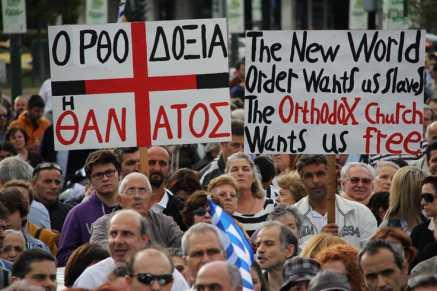
The Answer is Staring You in the Face

The Christian world outside the Orthodox Church appears to be in turmoil. Two billion people seem to be ever more leaderless in a world that is storm-struck. The overwhelming mood of the moment is that of drift and the drift is towards rapid and total secularisation.

Protestantism seems to be in dissolution, literally dissolving into secularism, as it does not have the spiritual force to resist the secular world. This is because Protestantism gave birth to secularism and so has always carried within itself the seeds of its own destruction. As an anti-sacral reaction to Catholicism, its very anti-sacral nature inevitably gave birth to secularity – the opposite of sacrality. Its half-way house is no house at all when the storm strikes.

Roman Catholicism has been shaken to its foundations by scandals, both financial and moral. It is difficult to know how many of the accusations are true, but if only some are true, the situation is grave. At a time when the world needs strong leadership, the Roman Catholic leadership has been compromised by its own misdeeds. No-one will believe those who do not practise what they preach. The tendency therefore is to reject everything out of hand.

Only your racial and cultural prejudices prevent you from seeing it. We have spent nigh on forty years trying to break those down, to make you see outside yourself. The answer is not in some fake version of Orthodoxy, Eastern-rite Anglicanism; the answer is in the real thing.